The public forum doctrine sorts government property into three legal categories, and which one applies decides whether your speech gets the strongest constitutional shield the courts offer or almost none at all. In traditional public forums like streets and parks, the government must clear strict scrutiny to restrict speech based on its content. In nonpublic forums, it only needs a reasonable, viewpoint-neutral justification. The First Amendment supplies the baseline rule against laws “abridging the freedom of speech,” but the Supreme Court has spent decades deciding how that rule bends depending on where you’re standing when you speak.
That’s the whole ballgame in one sentence, but the practical stakes are bigger than most people expect:
- A city sidewalk gets First Amendment protection that a military base’s internal mail system never will.
- The same protest sign can be constitutionally protected on a courthouse plaza and legally removable from an airport terminal.
- Government intent, not just the physical space, often decides which rules apply.
Key Takeaways
The forum category a court assigns almost always decides the outcome before the legal test is even applied, so identifying that category correctly is the single most important step in any speech dispute.
| Point | Details |
|---|---|
| Category drives the standard | Traditional and designated forums trigger strict scrutiny for content-based rules; nonpublic forums need only reasonableness. |
| Viewpoint discrimination is always banned | No forum category, however restrictive, permits the government to favor one side of a debate. |
| Intent and practice matter as much as policy | Courts look at what officials actually did, not just what a policy states, when deciding forum status. |
| Documentation protects your claim | Photos, permit denials, and prompt public-records requests build the evidence courts rely on. |
| Some speech stays unprotected everywhere | Incitement, true threats, and obscenity fall outside First Amendment coverage regardless of forum. |
Table of Contents
- What Are the Three Categories Under the Public Forum Doctrine?
- How Do Courts Decide Which Speech Rules Apply?
- How Do Courts Determine If a Space Is a Public Forum?
- What Should You Do If Your Speech Gets Restricted?
- When Should You Call Javitch Law Office?
- Where Did the Public Forum Doctrine Come From?
- Content-Based vs. Content-Neutral: Why the Distinction Decides Everything
- How the Doctrine Shapes Today’s Free Speech Fights
- What Limits Still Apply Even in Protected Forums
- Where to Read the Primary Sources
- The Doctrine’s Biggest Blind Spot
- Frequently Asked Questions
- Sources
What Are the Three Categories Under the Public Forum Doctrine?
Courts sort government property into three buckets, and each one comes with a different rulebook for reviewing speech restrictions. The First Amendment Encyclopedia frames this as the doctrine’s central function: matching the level of constitutional protection to the type of property involved.
- Traditional public forums. Streets, sidewalks, and parks fall here because they’ve been used for assembly and debate since long before the Constitution existed. Content-based restrictions on speech in these spaces face strict scrutiny, and the government cannot silence a viewpoint it dislikes.
- Designated and limited public forums. These are spaces the government didn’t have to open for speech but chose to, such as a school auditorium rented out for community meetings or a municipal theater. A limited public forum narrows that opening further, restricting use to certain groups or topics, like a “school meeting rooms reserved for school-related groups” policy. The Cornell Law School overview of Perry and Cornelius explains that courts look for affirmative government intent before finding a space designated for public discourse.
- Nonpublic forums. Airport terminals, military bases, and internal school mail systems belong here. The government manages them primarily for a purpose other than public debate, so it gets far more room to restrict speech, as long as the rule is reasonable and doesn’t target a specific viewpoint.
Each label carries real weight in litigation, since the category assigned to a piece of property often decides the case before a judge even reaches the merits.
How Do Courts Decide Which Speech Rules Apply?
Once a court settles on a forum category, the legal test that follows is largely mechanical. Content-based restrictions in traditional or designated public forums trigger strict scrutiny: the government must show the rule serves a compelling interest and is narrowly tailored, with no less-restrictive option available. Few regulations survive that bar.
Content-neutral rules get an easier ride through the time, place, and manner test. A city can require a parade permit or cap the volume of a sound system near a hospital, but the rule has to serve a real governmental interest and leave open ample alternative channels for the speaker to reach an audience. Ban a protest outright with no alternative venue, and the rule likely fails no matter how neutral it sounds on paper.
Nonpublic and limited forums get the most deferential standard: reasonableness. The government wins as long as its rule is rational and doesn’t discriminate based on viewpoint. Minnesota Voters Alliance v. Mansky is the case most attorneys point to here. The Supreme Court upheld a ban on political apparel inside polling places, treating the polling place as a nonpublic forum where order and voter privacy outweighed the speech interest, but it also warned that vague enforcement standards can tip a “reasonable” rule into unconstitutional territory.
A useful checklist for gauging a restriction’s strength:
- Is the rule aimed at what is said (content-based) or just when/where/how it’s said (content-neutral)?
- Does the space have a history of public debate, or was it opened deliberately by policy?
- Does the restriction leave you another realistic way to reach your audience?
- Does the rule apply evenly, or does it single out a viewpoint the government dislikes?
Packingham v. North Carolina extended the doctrine’s logic to digital spaces, with the Court striking down a law barring registered sex offenders from social media, reasoning that cutting people off from platforms functioning as modern public squares raised serious First Amendment concerns even outside the classic park-and-sidewalk context.
How Do Courts Determine If a Space Is a Public Forum?
Judges don’t just look at a map. They dig into three kinds of evidence to figure out what kind of forum they’re dealing with, and the answer can surprise people who assume “government property” automatically means “open to speech.”
- Official policy. Written rules, permit systems, and public statements about who can use the space and for what.
- Consistent practice. How the government actually behaves matters more than what a policy claims. Letting a few outside groups use a room occasionally doesn’t automatically create a designated public forum if the practice isn’t consistent or broad.
- Nature and normal use of the property. A courthouse hallway isn’t built for protest the way a public park is, and courts weigh that physical and functional context heavily.
Sidewalks and parks are the textbook traditional forum. A school meeting room opened to community groups after hours looks more like a limited public forum, restricted to certain subjects or users. Airport terminals and internal government mail systems land in nonpublic territory because their core function is transit or administration, not debate.
The trickier cases involve newer terrain: interactive spaces on a government official’s social media account, or specialty license plate programs. Courts have started treating an official’s social media comment sections as designated forums in some circumstances, since blocking constituents from replying can look like excluding them from a space the official opened for public interaction, an issue raised in litigation like Knight First Amendment Institute v. Trump.

Pro Tip: Before assuming a space is protected, ask whether the government affirmatively opened it for speech or just tolerated speech happening there. Tolerance alone rarely creates a designated public forum.
What Should You Do If Your Speech Gets Restricted?
Acting fast and documenting everything gives you leverage whether you end up negotiating with an agency or filing suit. Courts weigh contemporaneous evidence far more heavily than a recollection assembled months later.
- Document the moment. Photograph or video the restriction as it happens, note the date, time, and exact location, and record the names and badge numbers of any officials involved.
- Collect the paper trail. Save permit denials, citations, or written warnings, and write down witnesses’ contact information while memories are fresh.
- Request the reasoning in writing. Most agencies have an internal appeal process; ask for the specific policy or rule cited and whether it was applied consistently to others.
- File a public-records request. A FOIA or state public-records request can surface the permit logs, internal policies, and enforcement history that prove (or disprove) a consistent, viewpoint-neutral practice.
- Know when litigation makes sense. If the restriction is ongoing or likely to recur, an injunction or declaratory judgment may be the only real remedy. Courts examining these claims want to see exactly the kind of documentation and policy evidence gathered in steps one through four.
| Point | Details |
|---|---|
| Category decides the test | Traditional and designated forums trigger strict scrutiny for content-based rules; nonpublic forums only need reasonableness. |
| Document immediately | Photos, permit denials, and officials’ names preserve evidence courts weigh heavily later. |
| Policy vs. practice both matter | Courts examine written rules and actual government behavior, not just one or the other. |
| Public records reveal intent | FOIA requests for permit logs and internal policy can prove or disprove a consistent, viewpoint-neutral practice. |
When Should You Call Javitch Law Office?
If a government agency shut down your speech, denied a permit inconsistently, or blocked you from a space it otherwise opens to the public, that’s worth a serious legal look before the window for relief closes.
Javitchlawoffice handles First Amendment litigation nationwide, with hands-on experience filing FOIA and public-records requests to build the policy and practice evidence forum cases depend on. The firm can evaluate your case for free, send preservation and records requests before evidence disappears, and pursue injunctions or damages when a violation is provable.
Bring what you already have to a consultation: photos, denial letters, permit applications, and any names or badge numbers you recorded. Javitchlawoffice pairs that local, on-the-ground detail with the kind of First Amendment litigation strategy built for cases that carry national precedent value.
Where Did the Public Forum Doctrine Come From?
The doctrine’s roots trace back to Hague v. CIO in 1939, when the Supreme Court struck down a Jersey City ordinance requiring a permit for any public assembly, reasoning that streets and parks had “immemorially been held in trust for the use of the public” for communication and debate. That single phrase became the doctrinal seed for everything that followed.
For decades after Hague, courts applied the traditional-forum logic without much of a formal category system. That changed with Perry Education Association v. Perry Local Educators’ Association in 1983, where the Court laid out the three-tier framework still used today: traditional public forums, forums the government has designated for public use, and everything else. Perry itself involved a school district’s internal mail system, which the Court held was not a public forum simply because one teachers’ union had been granted access to it.
Cornelius v. NAACP Legal Defense and Educational Fund refined the analysis further in 1985, focusing courts on government intent as the deciding factor for whether a designated forum exists. The Court asked not just what the space looked like, but whether officials had deliberately opened it to indiscriminate public use.
What started as a rule about literal town squares has since stretched to cover school facilities, transit systems, and now digital spaces, a sign of how a doctrine built for 1930s sidewalks keeps getting stress tested against forms of public communication its authors never imagined.
Content-Based vs. Content-Neutral: Why the Distinction Decides Everything
A restriction’s fate almost always turns on one question: does it target what’s being said, or just how, when, or where it’s said? Content-based rules regulate speech because of its subject matter or message, and they draw the harshest judicial review available. A law banning “political” signs on public property but allowing “commercial” ones is content-based on its face, since an official has to read the sign to know which rule applies.
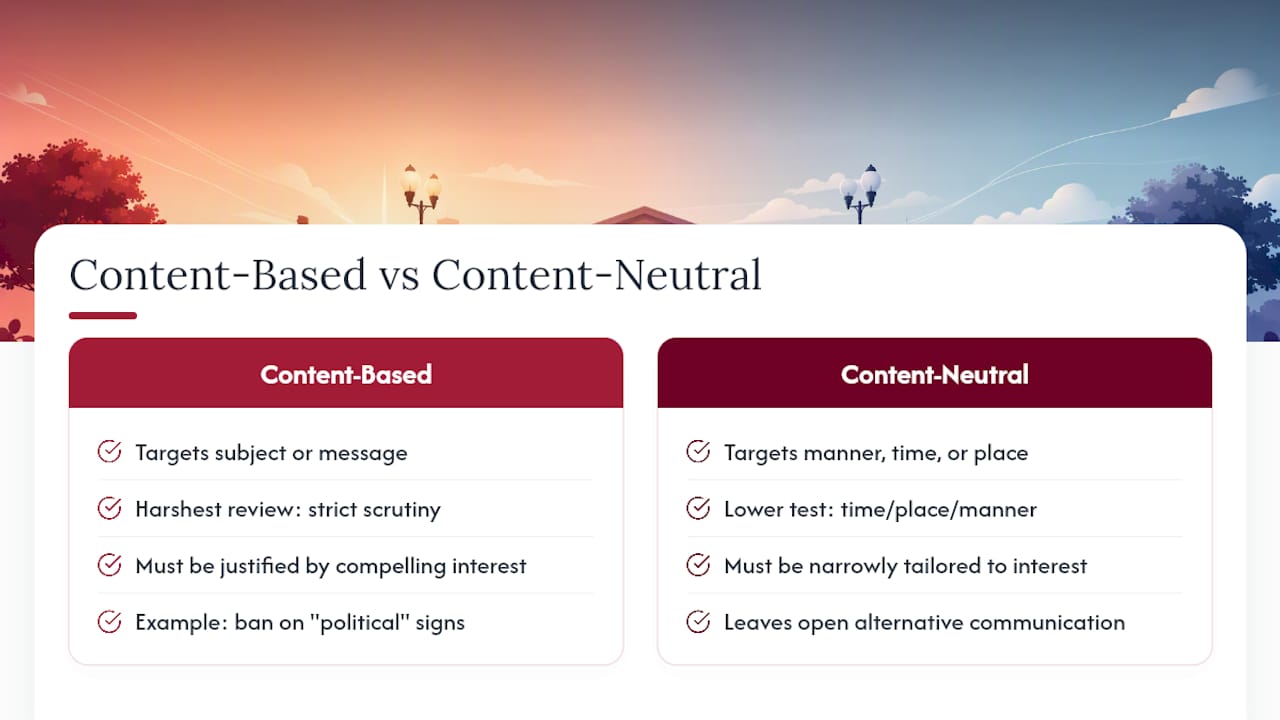
Content-neutral rules regulate the mechanics of speech without caring what it says. A noise ordinance capping decibel levels near a hospital after 10 PM applies the same way to a protest, a street musician, and a church group’s outdoor service. Courts still require these rules to be narrowly tailored to a real governmental interest and to leave open alternative ways to communicate, but the bar sits far lower than strict scrutiny.
The distinction gets messy in practice. A permit fee scaled to the size of an expected crowd sounds content-neutral, but if organizers can show it was calculated based on anticipated hostility toward a particular message, courts have found that content sneaking back in. Viewpoint discrimination, favoring one side of a debate over another, is unconstitutional in every forum category, even the most restrictive nonpublic ones. That single rule is the doctrine’s floor: whatever else a forum’s rules allow, they cannot pick winners and losers based on the opinion expressed.
How the Doctrine Shapes Today’s Free Speech Fights
The public forum doctrine’s biggest modern battleground isn’t a park bench, it’s a browser. Courts have had to decide whether a government official’s social media page functions like a nonpublic office memo or a designated forum open to public comment, with rulings like Knight First Amendment Institute v. Trump treating interactive comment sections as spaces the official had opened for public dialogue, making viewpoint-based blocking constitutionally suspect.
Packingham v. North Carolina pushed the doctrine’s logic further by recognizing social media platforms generally as the modern equivalent of the traditional public square, even though those platforms are privately owned. That’s an important nuance: the First Amendment restrains government action, not private company policy, so a platform’s own moderation decisions don’t trigger public forum analysis the way a government official’s account might.
Airport protests, courthouse steps demonstrations, and campus speaker controversies all get analyzed through this same three-category lens. A university’s designated free-speech zone, a state capitol’s plaza, a public library’s meeting room, each dispute starts with the same question: what kind of forum is this, and did the government’s rule match the standard that category demands? The doctrine doesn’t resolve every hard case cleanly, but it gives litigants and courts a shared framework instead of deciding each fight from scratch.
What Limits Still Apply Even in Protected Forums
Strong protection in a traditional public forum doesn’t mean anything goes. The Supreme Court has long recognized categories of speech that fall outside First Amendment protection entirely, regardless of forum: true threats, incitement to imminent lawless action, obscenity, and speech integral to criminal conduct. A protester in a public park still can’t incite a riot or issue a genuine threat and claim forum protection as a shield.
Time, place, and manner rules also survive inside even the most protected forums, so long as they’re content-neutral and narrowly tailored. A city can require a permit for a march that blocks traffic, cap amplified sound near residential areas at night, or limit the size of a demonstration for public safety reasons. None of that violates the doctrine, because none of it targets the message being conveyed.
Government employees and students face additional limits tied to their roles rather than the forum itself. A teacher’s classroom speech and a public employee’s official statements get less protection than the same words spoken on a public sidewalk after hours, since courts weigh the government’s interest in operating its own institutions alongside the speech interest at stake. None of these limitations undercut the doctrine’s core structure, they just remind readers that “protected forum” and “unlimited speech” are not the same thing.
Where to Read the Primary Sources
Start with the First Amendment text itself, then the First Amendment Encyclopedia’s doctrine overview and Cornell’s LII forums entry for case-by-case detail on Perry and Cornelius.
The Doctrine’s Biggest Blind Spot
Most explainers treat the three forum categories as a neat sorting exercise, as if you could look at a piece of government property and instantly know the rule that governs it. That’s not how litigation actually works. The category assigned to a space often gets fought over harder than the restriction itself, because government intent, shown through inconsistent policy or selective enforcement, is where these cases are actually won or lost.
The conventional advice, “know your rights,” undersells how much of this turns on paper trails nobody thinks to collect until it’s too late. A permit log showing the city approved three similar events but denied yours isn’t a footnote. It can be the whole case.
If you take one thing from this, prioritize documentation over outrage. A well timed public-records request, filed before an agency has reason to clean up its files, often does more for your claim than any amount of righteous frustration on social media. The doctrine rewards people who can prove a pattern, not just people who were right.
Frequently Asked Questions
What is the public forum doctrine in simple terms? It’s the legal framework courts use to decide how much First Amendment protection speech gets based on the type of government property involved, ranging from strict scrutiny in traditional public forums to a reasonableness standard in nonpublic ones.
What’s the difference between a designated and a limited public forum? A designated public forum is opened broadly by the government for public speech, while a limited public forum restricts that opening to specific groups or topics, such as a school meeting room reserved for education-related organizations.
Can the government ever restrict speech in a traditional public forum like a park? Yes, through content-neutral time, place, and manner rules, such as permit requirements or noise limits, as long as the rule serves a real governmental interest and leaves open other ways to communicate.
Does the public forum doctrine apply to private property or private social media companies? No. The First Amendment restrains government action only, so private property owners and private platforms generally aren’t bound by public forum analysis, though a government official’s own account may be treated differently.
What should I do first if a government official restricts my speech? Document everything immediately, photos, names, badge numbers, and written denials, then request the specific policy in writing and consider filing a public-records request before speaking with an attorney.
Sources
- Public Forum Doctrine | The First Amendment Encyclopedia
- forums | Wex | US Law | LII / Legal Information Institute
- First Amendment | U.S. Constitution