
If you match a court-approved class definition, you are already in the class. You do not need to sign up, hire a lawyer, or pay anyone. Your only real decision is whether to file a claim when a settlement is announced, or opt out if you want to sue separately.
Here is what to do right now:
- Check for an official notice or claims administrator site. If a settlement has been reached, you should have received a mailed or emailed notice. If you missed it, search the case name on classaction.org or PACER.
- Do not pay a third party to file your claim. Filing through the official administrator is always free. Services that charge a fee or require a subscription are unnecessary.
- Calendar every deadline from the notice. Courts set non-negotiable claim deadlines and opt-out windows. Missing either typically means losing your rights permanently.
- Contact Javitchlawoffice if your individual damages appear larger than a typical class share, or if you want to evaluate opting out.
Pro Tip: Save the official claims administrator URL directly from your court notice, not from a Google search. Phishing sites mimic legitimate claim portals and can steal your personal information.
Under Rule 23 of the Federal Rules of Civil Procedure, a class action is the legal framework that allows one or more plaintiffs to sue on behalf of a larger group. Membership is a factual question, not a form you fill out.
Table of Contents
- Where can you find currently open class action settlements?
- How does joining a class action actually work?
- Step-by-step: how to claim your share of a settlement
- What happens after you file, and when do you get paid?
- Do you need a lawyer, and when should you opt out?
- How to spot settlement scams and verify a legitimate claim site
- When consumer and discrimination class actions matter most
- Key Takeaways
- Authoritative sources and directories to bookmark
Where can you find currently open class action settlements?
The fastest way to find active settlements is to check a few reliable directories and then go directly to the official administrator site listed in the notice. Here are the primary resources:

| Resource | Best Used For | URL |
|---|---|---|
| ClassAction.org | Broad database of open lawsuits, settlements, and investigations | classaction.org |
| TopClassActions | Consumer settlement listings with deadline alerts | topclassactions.com |
| Consumer Action | Curated open-claims database with proof requirements noted | consumer-action.org |
| SettlementRadar | Step-by-step filing guides and settlement tracking | settlementradar.com |
| PACER | Federal court dockets for cases not yet at settlement | pacer.uscourts.gov |
For each listing you find, look for three things before doing anything else: the claim deadline, whether proof of purchase is required, and the official administrator URL. Consumer Action, for example, currently lists the Shimano defective crankset settlement with an upcoming claim deadline and the Hyundai/Kia defective airbag settlement with a substantial settlement amount and an upcoming claim deadline. Those are real, active cases with real money on the table.
A few additional tips for finding cases:
- Search PACER (Public Access to Court Electronic Records) if a case is still in litigation and has not reached settlement. You can search by company name, case number, or keyword.
- State court dockets vary by state. In California, the California Courts website provides public access to many civil filings.
- Sign up for email alerts on ClassAction.org and TopClassActions so new settlements matching your purchase history reach you automatically.
How does joining a class action actually work?
Most people picture “joining” as something active, like signing a petition or filing paperwork. The reality is almost the opposite. When a court certifies a class, membership is automatic for everyone who fits the class definition. You are in by default.
The two moments when you must actually do something are:
- At settlement: File a claim form to receive your share of the fund.
- Before the opt-out deadline: Submit a written opt-out if you want to preserve the right to sue independently.
Rule 23(b)(3) classes cover most consumer money-damage cases. These give you an opt-out window. If you do nothing, you stay in, receive whatever the settlement pays, and give up the right to sue separately over the same claims. Rule 23(b)(2) classes cover injunctive relief only (think policy changes, not cash) and typically have no opt-out right.
A common misconception is that you need to hire your own attorney to participate. In most settlements, the court-appointed class counsel already represents the entire class. Individual members just file claims. Plaintiff attorneys are paid from the settlement fund, not by you.
Pro Tip: If you never received a notice but believe you qualify, that does not disqualify you. Administrators use imperfect contact databases. Proactively checking major directories or PACER can prevent you from missing a valid claim.
Step-by-step: how to claim your share of a settlement
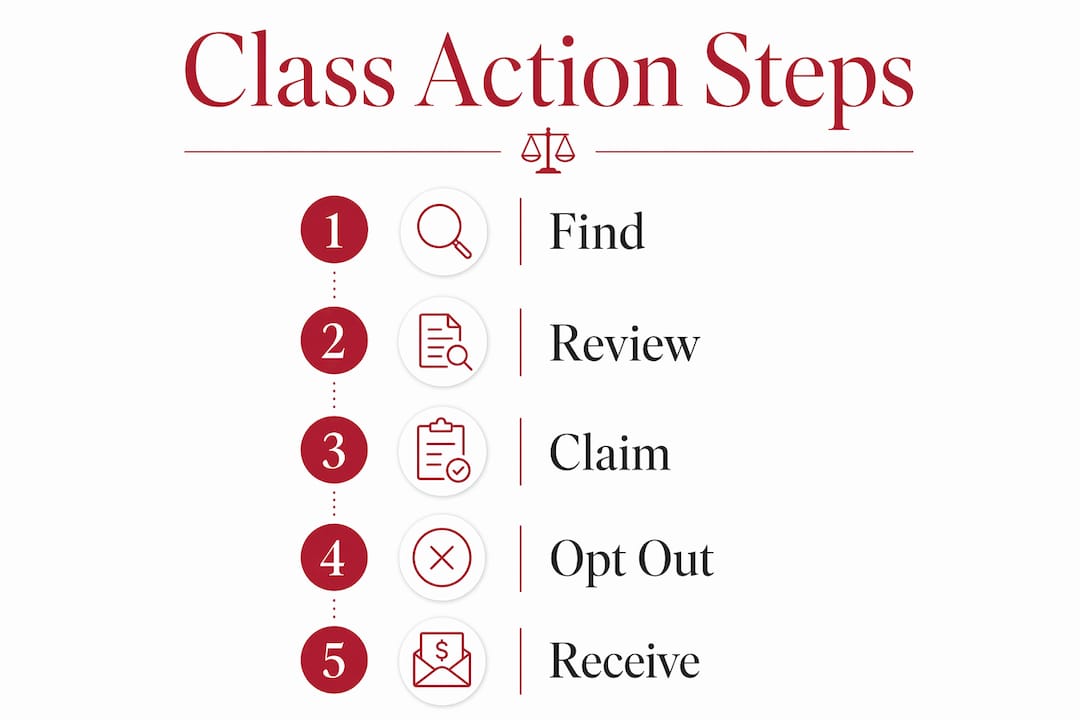
Once a settlement is announced and a claim period opens, the process is straightforward. Follow these steps in order:
-
Confirm you fit the class definition. Read the “Who Is Included” section of the official notice carefully. Class definitions are specific: they may require a purchase within a certain date range, ownership of a particular product model, or residence in a specific state.
-
Go to the official claims website listed in the notice. Never click a link from an unsolicited text or email. Type the URL directly into your browser or find it through a trusted directory. The official site is named in the court-approved notice.
-
Gather your documentation. Some settlements allow “no proof required” claims, where you certify your eligibility under penalty of perjury. Others require receipts, account numbers, product serial numbers, or proof of purchase. Check the settlement terms before you start filling out the form.
-
Complete and submit the claim form. Online portals are the fastest option and typically generate an immediate confirmation number. If you file by mail, use certified mail and note the postmark date. Courts distinguish between postmark deadlines and received-by deadlines, and the notice will specify which applies.
-
Save your confirmation. Screenshot or print the confirmation page. Write down your claim number. If the administrator’s portal allows status tracking, bookmark it. You may need this record months later if your claim is questioned.
Pro Tip: Use the administrator’s encrypted online portal whenever possible. It timestamps your submission, generates a confirmation number instantly, and eliminates the risk of a lost envelope.

What happens after you file, and when do you get paid?
Claim deadlines and payout timelines are two different things, and conflating them leads to frustration. The claim deadline is the date by which you must submit your form. Payment comes much later.
Here is the typical sequence after you file:
- Claims review: The administrator verifies submissions, checks for duplicates, and may request additional documentation for flagged claims.
- Final approval hearing: The court holds a fairness hearing to approve the settlement. Objectors can appear at this stage.
- Distribution: Once the court issues a final approval order, the administrator distributes funds. This can take weeks to months after the hearing.
- Appeals: If any party appeals the approval, distributions are frozen until the appeal resolves. Appeals can delay payment by a year or longer.
On the money itself: the gross settlement amount is not what you receive. Attorney fees and administrative costs are deducted from the fund first. What remains divides among all valid claimants. In large consumer settlements with millions of class members, individual payouts can be modest, sometimes under $20. In smaller, more targeted cases, they can be substantially higher.
Missing a claim deadline typically means losing your right to share in a settlement, even if you were a class member. Courts treat these deadlines as non-negotiable. Late submissions are almost always rejected, with no exceptions for oversight or technical difficulties.
If your claim is denied, check whether the administrator offers a “cure window,” a short period to correct deficiencies. You can also appeal a denial directly to the administrator or, in some cases, to the court. Contact information for both is listed in the official notice.
Do you need a lawyer, and when should you opt out?
For most people filing a standard consumer claim, the answer is no. The class counsel handles the litigation, and you simply submit a form. But there are situations where hiring your own attorney, or opting out entirely, is worth serious consideration.
Consider opting out if:
- Your individual damages are substantially larger than the average class share. A class settlement might pay $50 per person; your actual loss might be $5,000.
- The class definition is disputed and you are not confident you qualify.
- You want remedies the settlement does not provide, such as punitive damages or injunctive relief tailored to your situation.
- You have a strong individual claim under a statute with statutory damages, such as the TCPA, where per-violation damages can be significant.
Questions to ask a lawyer during a consultation:
- What is my realistic individual recovery if I opt out and sue separately?
- What are the attorney fees and litigation timeline for an independent claim?
- Does the class settlement release claims I might otherwise pursue?
- Is there a conflict between my interests and the class as a whole?
Class action attorneys typically work on contingency, meaning they collect a percentage of any recovery and charge nothing upfront. That structure makes legal consultation accessible even when you are unsure whether your case justifies opting out.
How to spot settlement scams and verify a legitimate claim site
The class action space attracts fraud. Scammers build fake claim portals, send phishing texts with short links, and charge fees for services that are always free through official channels.
Red flags to watch for:
- Any site or service that charges an upfront fee or requires a subscription to file a claim.
- Unsolicited texts or emails with shortened URLs and urgent language (“Act now or lose your payment”).
- Sites that ask for your Social Security number or bank account before you have confirmed the case is real.
- Pressure to act before you have located the official court notice.
Verification checklist:
- Match the domain in your court notice exactly to the URL you are visiting. One transposed letter is all a phishing site needs.
- Confirm the administrator’s name in the notice matches the site’s “About” or contact page.
- Search the case name on PACER or a reputable directory like ClassAction.org to confirm the settlement is real.
- Use only the contact information printed in the official notice to reach the administrator, never a number from a search result.
Legitimate settlement administrators never charge class members to file a claim, never promise faster payment for a fee, and always provide free status updates and confirmation numbers. If a service promises to speed up your payment for a fee, it is a scam.
If you suspect fraud, report it to the FTC at ReportFraud.ftc.gov, your state attorney general, and keep records of all communications. In California, the state AG’s office actively pursues consumer fraud cases.
When consumer and discrimination class actions matter most
Not every class action is a $50 coupon. Some cases involve serious harm: illegal robocalls, discriminatory lending, deceptive auto-renewal billing, or workplace discrimination affecting thousands of people. These are the cases where having experienced counsel makes a real difference.
Javitchlawoffice handles consumer class actions involving TCPA robocall violations, false pricing, and auto-renewal law cases, as well as discrimination and First Amendment matters. The firm operates with a nationwide reach from its California base, which matters when a class spans multiple states.
When to contact Javitchlawoffice directly:
- Your individual damages are large enough that a class share would not adequately compensate you.
- You are interested in serving as a named plaintiff, which carries additional responsibilities but also a potential service award.
- You need counsel to evaluate whether opting out and pursuing an independent claim is worth it.
- Your situation involves discrimination in employment, housing, or public accommodations alongside a consumer claim.
Pro Tip: Preserve documentation early, before a settlement is announced. Bank statements, call logs, subscription records, and purchase receipts are far easier to gather now than after a case closes. Javitchlawoffice also uses public records requests and FOIA filings to build cases when corporate records are not voluntarily produced.
Key Takeaways
Filing a class action claim costs nothing, requires no attorney in most cases, and the only way to lose your right to participate is to miss the court-set deadline.
| Point | Details |
|---|---|
| Membership is automatic | If you fit the class definition, you are already included — no sign-up required during litigation. |
| Act at settlement | Your two choices are filing a claim to collect money or submitting a written opt-out to sue separately. |
| Deadlines are non-negotiable | Courts reject late claims; calendar the claim deadline and opt-out window from the official notice immediately. |
| Payouts are reduced by fees | Attorney fees and administrative costs come out of the gross fund before individual distributions are calculated. |
| Javitchlawoffice can help | Contact the firm for a free consultation when individual damages are large, you want to opt out, or you need counsel for a consumer or discrimination class action. |
What most people get wrong about collective claims
Class actions get dismissed in two directions. Some people assume they are a lottery ticket and expect a big check. Others assume they are not worth the paperwork for a $30 payout. Both reactions miss the point.
The real value of a class action is not always the individual payment. It is accountability. When a company illegally charges millions of customers $9.99 a month through deceptive auto-renewal practices, no single customer has enough at stake to sue. Collectively, they do. The settlement forces a policy change, disgorges the ill-gotten revenue, and puts every similar company on notice. The $30 check is a byproduct, not the goal.
Where I see people leave real money on the table is in TCPA cases and discrimination claims. Statutory damages under the TCPA can reach $500 to $1,500 per violation. If you received 200 illegal robocalls, your individual claim could be worth far more than any class share. The same logic applies to employment discrimination: a class settlement might average $2,000 per person, but your individual claim, with documented harm, could be worth multiples of that. Those are the situations where opting out and hiring counsel is not just worth considering. It is often the right call.
The paperwork for a standard claim takes 10 minutes. The decision about whether to opt out deserves more than 10 minutes.
Javitchlawoffice: free case evaluation for class action and opt-out claims
If you are weighing whether to file a standard claim or pursue something larger, Javitchlawoffice offers a free case evaluation with no obligation. The firm handles consumer class actions including TCPA robocall violations, false pricing, and auto-renewal cases, as well as discrimination and First Amendment matters, on a contingency basis. You pay nothing unless the firm recovers for you.
That contingency structure matters because it aligns the firm’s incentives with yours. If opting out and suing independently is not worth it, a good attorney will tell you that in the consultation rather than take your case. Javitchlawoffice represents clients nationwide and has the experience to assess whether your individual damages justify a separate claim or whether filing with the class is the smarter move.
To get started, visit the firm’s consumer class actions page or contact Javitchlawoffice directly for a free consultation. Bring whatever documentation you have: call logs, receipts, account statements, or a copy of the class notice you received.
This article is general information, not legal advice. Confirm current deadlines and eligibility requirements with the official settlement administrator or a qualified attorney for your specific situation.
Authoritative sources and directories to bookmark
| Resource | What It Is Best For |
|---|---|
| ClassAction.org | Finding open lawsuits, settlements, and connecting with class action attorneys |
| TopClassActions.com | Consumer settlement listings with deadline tracking and email alerts |
| Consumer Action | Curated open-claims database with proof requirements and deadlines noted |
| SettlementRadar | Step-by-step filing guides and settlement status tracking |
| PACER (pacer.uscourts.gov) | Federal court dockets for active litigation not yet at settlement |
| FTC ReportFraud (reportfraud.ftc.gov) | Reporting settlement scams and fraudulent claim services |
A few practical notes on using these resources:
- ClassAction.org and TopClassActions are the best starting points for most consumer settlements. Both publish deadlines and link directly to official administrator sites.
- Consumer Action’s open-claims database is smaller but carefully curated, with clear flags for proof requirements.
- PACER requires a free account and charges a small per-page fee for documents, but it is the authoritative source for federal case records.
- State AG offices (in California, the California Department of Justice) maintain consumer complaint databases and sometimes publish information about active class actions affecting state residents.
Recommended
- Consumer Class Action Lawyers | TCPA, Auto Renewal, Price Rule
- Auto Renewal Law: How to Escape Unwanted Subscription Traps | Javitch Law Office
- TCPA Violations: Your Rights Against Unwanted Robocalls and Text Messages | Javitch Law Office
- Can You Sue for Robocalls to a Reassigned Phone Number? Yes—Here’s How | Javitch Law Office