
What qualifies as a hostile work environment under California law?
California sets a higher bar for employee protection than federal law does. Under the Fair Employment and Housing Act (FEHA), a hostile work environment exists when harassment based on a protected characteristic creates an intimidating, offensive, or abusive atmosphere that disrupts your ability to do your job. You do not need to show a demotion, pay cut, or firing. The law focuses on what happened to your working conditions, not your job title.

California explicitly rejects the federal “severe or pervasive” standard. Under Government Code § 12923, courts look at the totality of the circumstances, and a single serious incident can be enough to establish a claim. That is a meaningful distinction from what employees in other states face.
To establish a hostile work environment claim in California, you generally need to show five elements:
- You belong to a protected class
- You were subjected to unwelcome harassment
- The harassment was based on your protected status
- The conduct interfered with your work performance or created an abusive environment
- Your employer is liable (knew or should have known and failed to act)
The standard for judging hostility is objective: would a reasonable person in your position find the conduct hostile or abusive? Your subjective distress matters, but it alone is not enough.
Which behaviors and characteristics does California law protect?
FEHA covers a broad range of protected characteristics. If harassment targets any of the following, it can form the basis of a hostile workplace claim:
- Race, color, national origin, and ancestry
- Sex, gender identity, and gender expression
- Sexual orientation
- Religion
- Disability and medical condition
- Genetic information
- Age (40 and older)
- Pregnancy and related conditions
- Military and veteran status
Conduct that creates a hostile environment includes offensive jokes and slurs, name-calling, intimidation, ridicule, unwanted physical contact, and sexual harassment. These behaviors often form a pattern, but as noted above, one severe incident can suffice. A racial slur shouted at an employee, for example, can legally alter working conditions on its own.
Employers carry a direct legal duty here. Government Code § 12940(k) requires every California employer to take reasonable steps to prevent and promptly correct harassment. Failing to act once a complaint is made creates its own liability exposure, separate from the underlying harassment.

Pro Tip: If you witness harassment directed at a coworker, document what you saw. Bystander accounts often become critical corroborating evidence in hostile workplace claims.
How do you prove a hostile work environment in California?
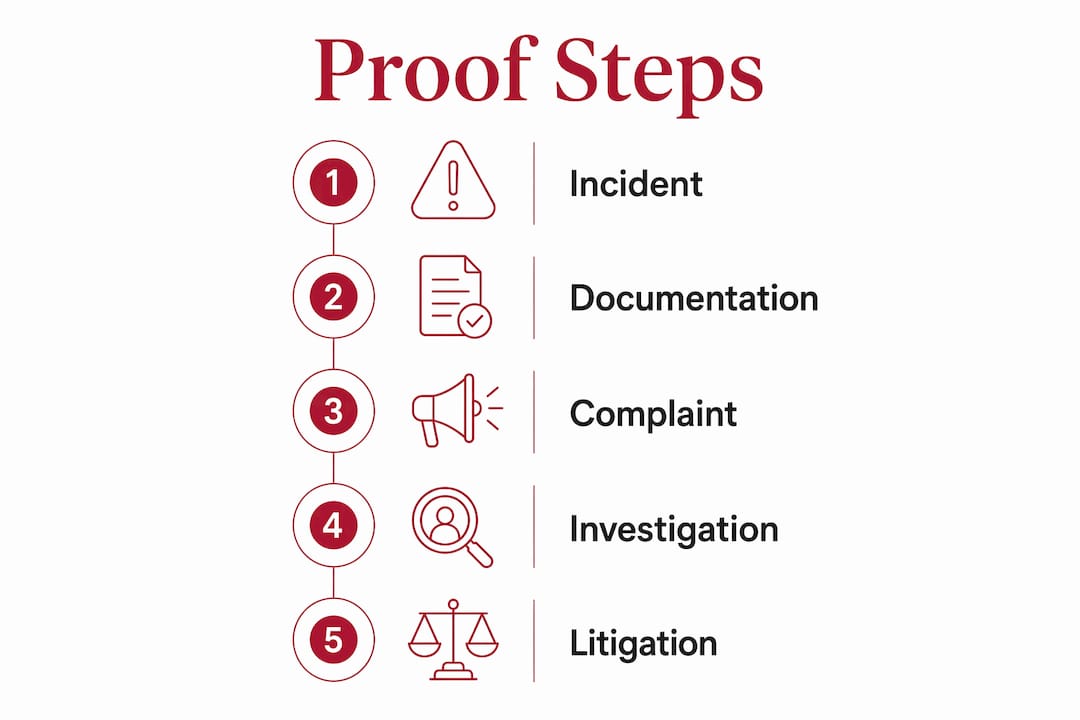
Proof comes down to five elements, and the weakest link in most cases is documentation. Courts want specifics, not impressions. Vague statements like “my boss was always mean to me” rarely move a case forward. What does move a case forward is a dated log that records exactly what was said, who was present, and how it affected your ability to work.
The California Civil Rights Department’s Harassment Prevention Guide emphasizes contemporaneous records with direct quotes, witness names, and concrete descriptions of how each incident affected your job performance. Write entries the same day the incident occurs, while details are fresh.
Beyond documentation, you need to show:
- The harassment was unwelcome (you did not invite or encourage it)
- It was tied to a protected characteristic, not just general rudeness
- A reasonable person in your position would find the environment hostile
- Your employer knew or should have known about the conduct
The 2024 California Supreme Court ruling in Bailey v. San Francisco District Attorney’s Office reinforced that employers can be held liable for isolated severe harassment by coworkers, with no requirement for a formal adverse job action. That ruling matters because it closes a gap some employers tried to exploit.
Pro Tip: Keep your documentation somewhere outside of work, such as a personal email draft or a notebook at home. Workplace systems can be accessed or deleted by employers during an investigation.
What should you do if you are experiencing a hostile work environment?
Acting quickly protects your legal rights. Here is a practical sequence:
- Document every incident as it happens. Date, time, location, exact words used, witnesses present, and how it affected your work.
- Review your employee handbook for the company’s harassment reporting procedure. Most policies require you to report to HR or a designated supervisor.
- Report the conduct in writing to HR or your supervisor. Email creates a paper trail. If your supervisor is the harasser, go directly to HR or their manager.
- Keep copies of all communications related to your complaint, including any responses from HR.
- Contact the California Civil Rights Department (formerly DFEH) to file a formal complaint. You generally must file within one year of the last incident to preserve your rights.
- Consult an employment attorney before signing anything, including settlement agreements or separation paperwork.
If your workplace has a pattern of ignoring complaints, or if you face retaliation after reporting, those facts strengthen your case. Retaliation itself is a separate violation under FEHA. For guidance on handling difficult workplace conversations before escalating formally, outside resources can help you prepare.
What damages and remedies can you recover?
California law gives courts and administrative agencies real tools to compensate victims and correct employer behavior. Remedies in a successful hostile work environment claim can include:
- Emotional distress damages for the psychological harm caused by the harassment
- Lost wages if the hostile conditions forced you to quit or affected your earnings
- Punitive damages when an employer’s conduct was especially malicious or oppressive
- Injunctive relief, meaning a court order requiring the employer to change policies, conduct training, or take other corrective action
- Attorney’s fees and costs, which California law allows prevailing employees to recover
The statute of limitations under FEHA is generally one year from the date of the last discriminatory act to file a complaint with the California Civil Rights Department. Missing that deadline can forfeit your right to pursue the claim entirely, so timing matters.
How is a hostile work environment different from workplace discrimination?
These two concepts overlap but are not the same thing. Understanding the difference helps you frame your situation accurately when talking to an attorney or filing a complaint.
| Feature | Hostile Work Environment | Workplace Discrimination |
|---|---|---|
| Core focus | Harassing conduct that poisons the work atmosphere | Adverse employment action based on protected status |
| Requires job loss or demotion | No | Usually yes (firing, demotion, pay cut) |
| Legal basis | FEHA harassment provisions | FEHA discrimination provisions |
| Proof of tangible harm | Altered working conditions suffice | Concrete employment consequence required |
| Single incident enough | Yes, if severe | Typically requires a pattern or clear adverse action |
Discrimination typically involves a concrete employment decision: you were passed over for a promotion because of your race, or fired because of your disability. A hostile environment claim focuses on the atmosphere itself. Both can exist in the same situation, and many strong cases involve both theories.
Where do you file a complaint in California?
The California Civil Rights Department (CCD, formerly the Department of Fair Employment and Housing or DFEH) is the primary state agency for workplace harassment complaints. Filing with the CCD is a prerequisite to filing a civil lawsuit under FEHA in most cases.
You can also file a parallel complaint with the federal Equal Employment Opportunity Commission (EEOC), though California’s protections are generally broader. The CCD and EEOC have a work-sharing agreement, so filing with one typically cross-files with the other.
Once you file, the CCD may investigate, attempt mediation, or issue a right-to-sue notice. A right-to-sue letter opens the door to filing a civil lawsuit in California Superior Court. For information on how workplace culture rebuilding fits into post-complaint recovery, external resources offer practical frameworks.
What does the legal process actually look like?
Most hostile work environment cases move through several stages before reaching a courtroom, and many resolve before trial.
1. Internal complaint. You report to HR or a supervisor. The employer is legally required to investigate promptly. Under the DFEH Workplace Harassment Guide, investigations must be conducted by someone with knowledge of investigatory practices, and the employer must protect complainants from retaliation throughout the process.
2. Agency complaint. You file with the California Civil Rights Department. The agency reviews the complaint, may conduct its own investigation, and can attempt mediation between you and your employer.
3. Mediation. Many cases settle at this stage. A neutral mediator helps both sides reach an agreement without going to court. Settlements can include monetary compensation and policy changes.
4. Right-to-sue notice. If mediation fails or you choose to bypass it, the CCD issues a right-to-sue letter. You then have a limited window to file a civil lawsuit.
5. Litigation. Your attorney files suit in California Superior Court. The case proceeds through discovery, depositions, and potentially trial. As Government Code § 12923 notes, harassment cases are rarely appropriate for summary judgment, meaning most reach a fuller hearing.
Javitchlawoffice can help you take action
If you are dealing with a hostile workplace in California, you need an attorney who understands both the law and what it takes to hold employers accountable. Javitchlawoffice is a California-based civil rights firm that handles employment discrimination and harassment claims with the depth and tenacity these cases demand. The firm combines local knowledge of California employment law with the resources to take on powerful institutions.
Contact Javitchlawoffice for a case evaluation and find out where you stand.
Key Takeaways
California’s hostile work environment protections under FEHA are stronger than federal law, and a single severe incident can be enough to support a legal claim without any formal job loss.
| Point | Details |
|---|---|
| One incident can be enough | California law allows a single severe act to establish a hostile environment claim under § 12923. |
| Five elements required | You must show protected class membership, unwelcome harassment, protected-status basis, work interference, and employer liability. |
| Document immediately | Contemporaneous logs with exact quotes and witness names are the difference between a strong and a weak case. |
| File within one year | The California Civil Rights Department complaint deadline is generally one year from the last incident. |
| No job loss required | A hostile environment claim focuses on altered working conditions, not firings or demotions. |
Recommended
- Antisemitic & Racial Discrimination Attorneys | Javitch Law Office
- Jewish Discrimination in the Workplace: Know Your Rights and Legal Options | Javitch Law Office
- California Public Records Act Lawyer: Enforcing Your Right to Government Transparency | Javitch Law Office
- Fighting Antisemitic and Racial Discrimination in the Workplace | Javitch Law Office