Prior restraint is government action that stops speech before it happens rather than punishing it afterward, and American courts treat it as the most dangerous form of censorship the First Amendment recognizes. Any government attempt to block publication, speech, or expression in advance meets what the Supreme Court calls a “heavy presumption” against its constitutional validity, and the government carries a steep burden to justify it.
Judges rarely let that burden get met. Common forms of prior restraint include:
- Temporary restraining orders (TROs) and injunctions barring speech before it occurs
- Gag orders in criminal or civil proceedings
- Licensing or permit schemes that give officials discretion over who gets to speak
- Prepublication review requirements imposed on government employees or contractors
Key Takeaways
Courts presume every prior restraint is unconstitutional, and the government must prove direct, immediate, and irreparable harm to overcome that presumption.
| Point | Details |
|---|---|
| Heavy presumption controls | Courts start from the assumption a prior restraint is unconstitutional and require the government to prove otherwise. |
| Near and Pentagon Papers set the bar | Both cases rejected government censorship claims that relied on generalized harm rather than direct, immediate proof. |
| Exceptions are extremely narrow | Only cases like United States v. Progressive show a court allowing even temporary prepublication restraint. |
| Post-publication liability still applies | Defeating a prior restraint doesn’t shield a publisher from later defamation, obscenity, or criminal claims. |
| Speed determines outcomes | Contacting Javitch Law Office’s First Amendment attorneys quickly after a restraint threat improves the odds of emergency relief. |
Primary Sources and Further Reading
- Near v. Minnesota case background | Britannica
- New York Times Co. v. United States opinion | GovInfo
- Prior restraint doctrine overview | Cornell LII
- Prior restraint historical background | The First Amendment Encyclopedia
This article is general information, not a substitute for advice from a qualified lawyer. Consult a qualified legal professional about your own circumstances before acting on anything here.
Table of Contents
- What Is the Legal Standard for First Amendment Prior Restraint?
- What Are the Landmark First Amendment Prior Restraint Cases?
- What Are Common Modern Forms of Prior Restraint?
- When Is Prior Restraint Allowed Under the First Amendment?
- How Does Prior Restraint Differ From Post-Publication Liability?
- What Should You Do if You Face a Prior Restraint?
- How Do Attorneys Challenge a Prior Restraint in Court?
- A Practitioner’s View on Fighting Prior Restraint
- Get Help From Javitch Law Office if You Face an Unlawful Restraint
- Sources
What Is the Legal Standard for First Amendment Prior Restraint?
Courts don’t evaluate prior restraint the way they evaluate an ordinary content restriction. They start from a presumption that the restraint is unconstitutional, then ask whether the government has overcome it. The Legal Information Institute’s constitutional analysis captures the standard the Supreme Court has repeated for decades.
That single sentence does most of the doctrinal work. In practice, it means the government cannot rely on speculation, general anxiety about harm, or an official’s gut feeling that something bad might happen. It must show the harm is direct, immediate, and, in national security cases, close to inevitable. The Cornell Law Wex definition of prior restraint frames this as a heavy burden the government must actively carry, not a presumption the speaker has to rebut.
Judges weigh several factors when a restraint request lands on their desk:
- Whether the speech at issue is core political or press speech, which gets the strongest protection
- How urgent and specific the claimed harm actually is
- Whether a less restrictive option, like a protective order or post-publication penalty, could handle the harm just as well
- Whether the restrained party gets a fast, meaningful chance at judicial review before the restriction takes effect
That last factor matters more than people expect. A restraint imposed without a real opportunity to contest it in court is far more vulnerable on appeal than one that followed a full adversarial hearing.
What Are the Landmark First Amendment Prior Restraint Cases?
Five decisions do most of the work in shaping how American courts handle prior restraint today. Each one answers a different version of the same question: how much proof does the government need before a judge can stop speech in advance?
- Near v. Minnesota, 283 U.S. 697 (1931). The Supreme Court struck down a Minnesota statute that let judges permanently shut down “malicious” or “scandalous” newspapers. This was the foundational ruling. The Court held that stopping a publication before it prints, even one accusing officials of corruption, is exactly the kind of censorship the First Amendment was written to prevent.
- New York Times Co. v. United States, 403 U.S. 713 (1971), the Pentagon Papers case. The government tried to block the Times and the Washington Post from publishing classified material on the Vietnam War. The per curiam opinion in the official Supreme Court reporter held that the government hadn’t shown publication would cause direct, immediate, and inevitable harm. National security claims, standing alone, don’t clear that bar.
- Nebraska Press Association v. Stuart, 427 U.S. 539 (1976). A trial judge issued a gag order barring the press from reporting details of a murder case to protect the defendant’s fair-trial rights. The Court struck it down, ruling that even a legitimate competing interest like a fair trial doesn’t automatically justify silencing the press in advance.
- United States v. Progressive, Inc. (W.D. Wis. 1979). A federal district court briefly enjoined a magazine from publishing an article describing hydrogen bomb design, one of the rare modern instances where a prepublication restraint actually took effect. The government dropped the case after the information became public elsewhere, and the episode remains a cautionary tale about how narrow this exception really is.
- Hazelwood School District v. Kuhlmeier, 484 U.S. 260 (1988). The Court held that school officials could exercise editorial control over a school-sponsored student newspaper without running afoul of the First Amendment, applying a far more permissive standard than Near or the Pentagon Papers case. Schools operate under different rules than the general public.
What Are Common Modern Forms of Prior Restraint?
Prior restraint doesn’t always look like a government official blocking a newspaper. It shows up in quieter, more everyday legal disputes.
- TROs and preliminary injunctions stop speech before a court has fully adjudicated the underlying claim.
- Civil injunctions in private disputes, such as one party asking a judge to bar an ex-business partner from discussing a contract dispute online.
- Gag orders in criminal cases, restricting what attorneys, witnesses, or the press can say about an ongoing trial.
- Permitting and licensing schemes that require government approval before a rally, parade, or public demonstration.
- School or campus review of student publications and speech.
- Prepublication review required of government employees or contractors with access to classified material.
One recurring modern example involves civil litigants seeking broad injunctions that bar someone from speaking publicly about a dispute at all. The American Bar Association has described overbroad no-comment injunctions arising out of a medical dispute as a “classic example of a prior restraint,” precisely because they silenced truthful speech about a matter of public concern before any court decided the underlying claim was false.
Pro Tip: If a licensing or permit system gives an official unlimited discretion to approve or deny a request, with no neutral, published standard to apply, that’s a red flag. Courts have consistently found these schemes function as covert content-based prior restraints, even when they’re dressed up as routine paperwork.
When Is Prior Restraint Allowed Under the First Amendment?
Almost never, and courts want that scarcity understood clearly before anyone assumes an exception applies to their situation. The government can theoretically justify a restraint only when it proves the harm is close to certain, immediate, and severe enough that no other remedy will work.
The Pentagon Papers opinion set the tone with language requiring proof the government’s claimed harm was virtually certain, direct, and immediate, not merely plausible or feared.
The government must show that publication “will surely result in direct, immediate, and irreparable damage” to the nation, and speculation about possible harm falls well short of that standard.
Before a court will even consider a restraint, it typically expects the government to show it has exhausted less restrictive options:
- Prosecuting the leaker or source after the fact, rather than gagging the publisher
- Seeking a protective order narrowly tailored to specific evidence or testimony
- Requesting an expedited hearing on the merits instead of an emergency freeze
- Redacting or sealing narrow categories of information rather than blocking the entire publication
How Does Prior Restraint Differ From Post-Publication Liability?
The First Amendment blocks the government from stopping speech in advance. It does not grant immunity from what happens after that speech goes out into the world. A publisher who escapes a prior restraint can still face a defamation suit, an obscenity prosecution, or, in rare cases involving genuinely classified material, a criminal case for unlawful disclosure. The doctrine explained by Justia draws this line clearly: prior restraint law protects the moment before publication, not the consequences that follow it.
| Feature | Prior Restraint | Post-Publication Sanction |
|---|---|---|
| Timing | Blocks speech before it occurs | Punishes speech after it occurs |
| Legal standard | Heavy presumption against validity; near-impossible burden | Ordinary civil or criminal standards apply |
| Typical remedy sought | TRO, injunction, gag order | Damages, fines, criminal conviction |
| Example | Blocking publication of a leaked report | Suing for libel after the report runs |
This distinction is also why a permanent injunction issued after a full trial, once a court has actually found speech to be defamatory or otherwise unprotected, doesn’t carry the same constitutional weight as an emergency order issued before any adjudication took place.
What Should You Do if You Face a Prior Restraint?
Speed matters more than almost anything else once a restraining order or gag order is on the table. Move through these steps in order:
- Preserve every document, email, and recording connected to the speech at issue before anything gets lost or altered.
- Do not violate the order, even if you believe it’s unconstitutional. Courts punish violations harshly, and disobedience can undercut your appeal.
- Photograph or record any seizure, notice, or enforcement action the moment it happens.
- Contact experienced First Amendment counsel immediately. Hours matter in these cases far more than in ordinary civil litigation.
- Move to quash, stay, or narrow the order and request an expedited hearing rather than waiting for a normal court calendar slot.
Pro Tip: If a judge denies your motion to lift a restraint, ask the court to state its reasoning on the record and request only limited, specific compliance rather than agreeing to broad terms. A clean record of narrow stipulations preserves stronger grounds for appeal than a vague, blanket agreement to comply.
How Do Attorneys Challenge a Prior Restraint in Court?
Experienced First Amendment lawyers rarely win these cases by arguing abstract principles. They win by attacking the government’s factual showing.
- Forcing the government to put its claimed emergency on the record, under oath, rather than relying on unsupported assertions
- Arguing there’s no causal nexus between the speech and the harm the government claims will follow
- Demonstrating a less restrictive alternative exists, undercutting the argument that a full restraint is necessary
- Attacking overbroad language in a proposed order, since a restraint that sweeps in protected speech alongside any legitimately restricted material is far easier to defeat
- Seeking an immediate stay or emergency appeal rather than waiting through the ordinary appellate timeline
Pro Tip: The moment a court asks the government to justify its emergency claim in detail, on the record, the government’s case often collapses. That procedural pressure defeats more restraint requests than any single substantive argument.
A Practitioner’s View on Fighting Prior Restraint
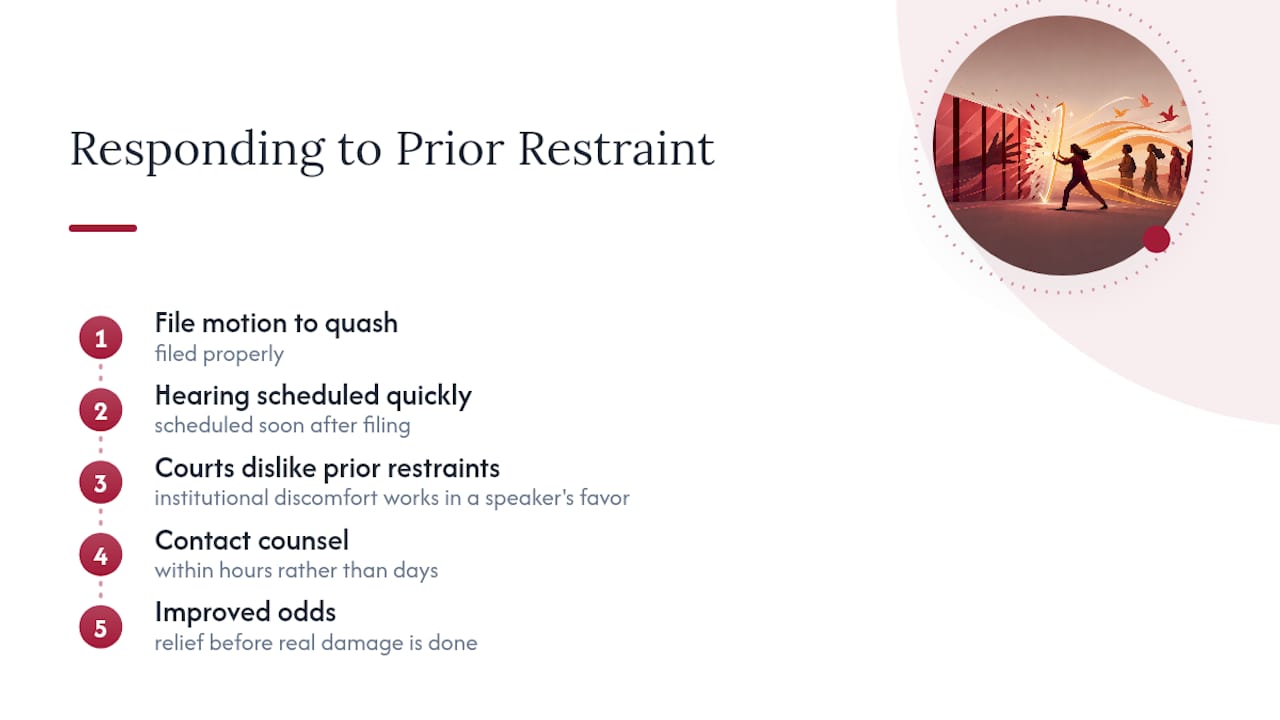
Cases like this move fast, and clients are usually surprised by how quickly a hearing gets scheduled once a motion to quash is filed properly. Courts genuinely dislike prior restraints, and that institutional discomfort works in a speaker’s favor more often than people expect. If you contact counsel within hours rather than days, you dramatically improve your odds of getting relief before real damage is done.
Get Help From Javitch Law Office if You Face an Unlawful Restraint
If you’re staring down a gag order, an injunction, or a licensing denial that smells like content-based censorship, waiting to see what happens is the costliest option on the table.

Javitch Law Office handles First Amendment matters that demand exactly this kind of speed, including emergency motions to stay or quash a restraint and expedited appellate work when a lower court gets it wrong. The firm’s First Amendment attorneys have experience pushing back against injunctions and gag orders that reach further than the law allows, and that includes cases where a school, employer, or private party is trying to silence someone before a court has ever ruled on the underlying dispute. If the restraint touches a student publication or campus speech issue, the firm’s student discrimination practice covers that ground as well.
There’s no cost to find out where you stand. Reach out to the First Amendment legal team for a prompt case evaluation before a deadline or hearing date closes off your options.
Sources
- prior restraint | Wex | US Law | LII / Legal Information Institute
- Procedural Matters and Freedom of Speech: Prior Restraints | U.S. Constitution Annotated | US Law | LII
- NEW YORK TIMES CO. v. UNITED STATES (403 U.S. 713)
- Prior restraint | The First Amendment Encyclopedia
- Prior restraint | Britannica