
What does FEHA protect California workers from?
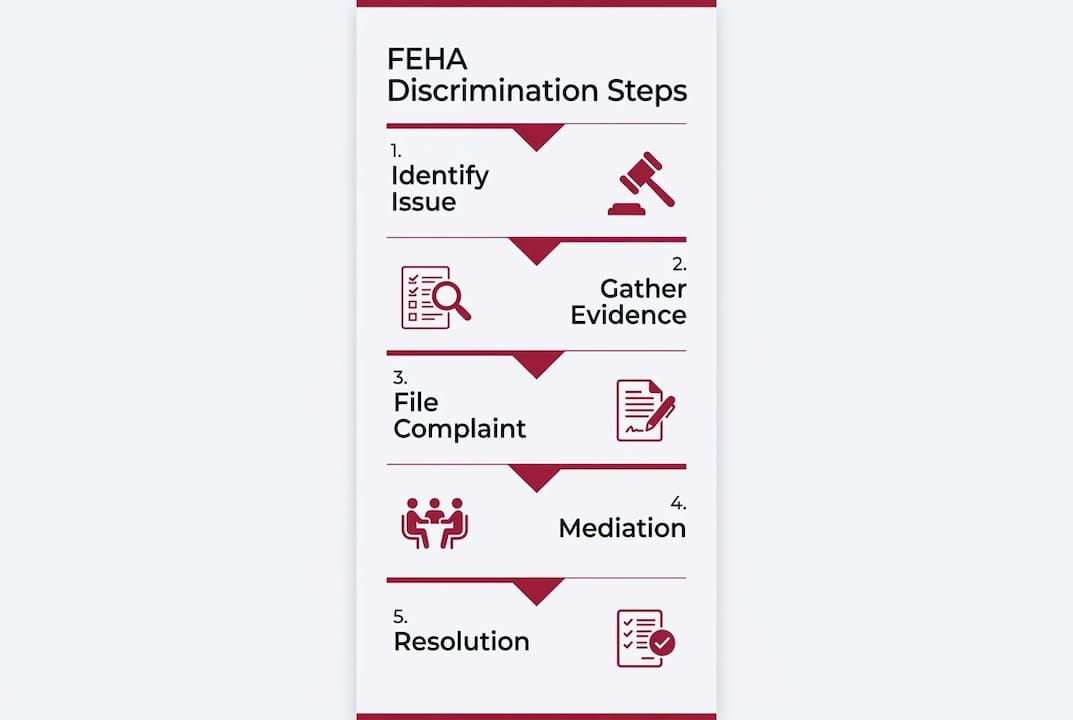
California’s Fair Employment and Housing Act gives workers some of the strongest anti-discrimination protections in the country. FEHA discrimination covers unlawful bias in hiring, firing, promotion, pay, and working conditions based on a broad list of protected characteristics. If you work in California and believe your employer treated you unfairly because of who you are, FEHA is the law that applies.
Key facts about FEHA’s scope:
- General discrimination protections apply to employers with five or more employees; harassment protections apply to every workplace, even those with a single employee or contractor
- Coverage extends beyond traditional employees to include job applicants, unpaid interns, volunteers, and contractors
- Protected characteristics span race, color, religion, sex, national origin, age (40 and over), disability, sexual orientation, gender identity, medical condition, genetic information, marital status, military or veteran status, and reproductive health decisions
- Prohibited conduct includes harassment, disparate treatment, failure to accommodate, and retaliation
- Remedies include compensatory and punitive damages, reinstatement, injunctive relief, and attorney’s fees
What counts as employment discrimination under FEHA?
FEHA discrimination is not limited to an outright firing. The law covers any adverse employment action tied to a protected characteristic, and the conduct does not have to be intentional to be unlawful.
Common forms of prohibited conduct include:
- Disparate treatment: Paying a Latina employee less than equally qualified male colleagues for the same role
- Hostile work environment: Repeated racial slurs or offensive jokes that management ignores despite complaints
- Failure to accommodate: Refusing to adjust a work schedule for an employee’s documented disability without exploring alternatives
- Retaliation: Demoting a worker shortly after they filed an internal discrimination complaint
- Discriminatory hiring: Screening out applicants based on accent, name, or perceived national origin
Indirect discrimination is just as actionable as direct discrimination. A neutral policy that disproportionately harms a protected group, such as a physical fitness test that screens out older workers without a legitimate business reason, can violate FEHA. FEHA also prohibits retaliation against anyone who opposes a discriminatory practice, files a complaint, or assists in an investigation.
Which characteristics does FEHA protect?

California’s protected class list goes further than federal law. Title VII and the Americans with Disabilities Act cover the basics; FEHA adds categories that federal statutes do not explicitly include.
FEHA-protected characteristics include:
- Race, color, ancestry, and national origin
- Religion and creed (including religious dress and grooming practices)
- Age (40 and over)
- Sex and gender, including pregnancy, childbirth, and breastfeeding
- Sexual orientation
- Gender identity and gender expression
- Disability, both physical and mental (California’s definition is broader than the federal ADA standard)
- Medical condition, including cancer and genetic characteristics
- Genetic information
- Marital status
- Military or veteran status
- Reproductive health decision-making
Pro Tip: If you are unsure whether your situation involves a protected characteristic, the California Civil Rights Department (CRD) accepts complaints across all of these categories and can help clarify your eligibility before you commit to a formal filing.
What remedies can you recover in a FEHA discrimination case?
FEHA gives prevailing plaintiffs meaningful financial and non-financial relief. The remedies available depend on the facts of the case, but the range is broader than most workers realize.
- Compensatory damages: Lost wages, lost benefits, and emotional distress damages
- Punitive damages: Available when a corporate officer, director, or managing agent personally engaged in or consciously approved the discriminatory conduct
- Reinstatement or hiring orders: A court can order your employer to rehire you or place you in the position you were denied
- Injunctive relief: Courts can require employers to change discriminatory policies, conduct training, or take other corrective steps
- Attorney’s fees and litigation costs: Prevailing plaintiffs are typically entitled to fee awards, which is a significant advantage over many federal anti-discrimination laws and makes it financially viable to pursue a case even without upfront funds
Settlement is far more common than a full trial. Most FEHA cases resolve through negotiation or mediation after the administrative process, which keeps costs lower and timelines shorter for both sides.
How do you file a FEHA discrimination complaint with the CRD?
Filing correctly and on time is the single most important procedural step. Miss the deadline and you lose the right to pursue your claim.
- Confirm your eligibility. Any employee, applicant, unpaid intern, volunteer, or contractor can file an employment discrimination complaint with the California Civil Rights Department.
- File within three years. A complaint of employment discrimination must generally be filed within three years of the alleged discriminatory act. Minors get an extended deadline: complaints must be filed no later than one year after their 18th birthday.
- Submit your complaint to the CRD. You can file online, by mail, or in person. Include dates, descriptions of the conduct, and any documentation you have.
- Request a Notice of Right to Sue if needed. If you want to go directly to court rather than wait for the CRD’s investigation, you can request an immediate Right to Sue notice at the time you file.
- Exhaust administrative remedies first. You must file with the CRD before bringing a civil lawsuit, unless you have already obtained a Right to Sue notice. Skipping this step bars your court case.
What happens after you file? The CRD investigation process
Once the CRD receives your complaint, it does not go into a black hole. The agency follows a structured review process, though timelines vary by case complexity.
- Initial intake and review: The CRD screens the complaint to confirm it falls within FEHA’s jurisdiction. Complaints involving non-FEHA issues, such as general wage disputes without a discrimination angle, are redirected.
- Mediation offer: The CRD typically offers both parties a chance to resolve the matter through mediation before a full investigation begins. Mediation is voluntary and confidential.
- Evidence gathering: If mediation fails or is declined, investigators collect documents, conduct interviews with witnesses, and review employer policies.
- Investigation findings: The CRD issues a determination of whether there is sufficient evidence to support the complaint. A finding of cause can lead to a settlement conference or referral for litigation.
- Record retention and confidentiality: Investigation files are treated as confidential during the process. The CRD does not inquire about a complainant’s citizenship or immigration status, and California law protects workers regardless of immigration status.
Top California employment law firms for FEHA discrimination cases
Seven firms stand out for California workers navigating FEHA claims, ranging from large plaintiff-side practices to boutique civil rights offices.
| Firm | Specializations | Pricing | Rating | Best For |
|---|---|---|---|---|
| D.Law, Inc. | Discrimination, harassment, wrongful termination, retaliation, wage claims | No upfront cost; contingency | 4.7★ | Employees seeking broad employment law coverage |
| Lawyers for Employee and Consumer Rights | Wrongful termination, FEHA discrimination, wage claims, whistleblower protection | Free case review; no upfront cost | 4.3★ (714 reviews) | Workers needing litigation support for termination and bias |
| Kokozian Law Firm, APC | Disability, pregnancy, race, age, sexual orientation discrimination; retaliation; unpaid wages | Contingency; no fees unless they win | 4.8★ (104 reviews) | Employees wanting specialized discrimination and retaliation litigation |
| The Nourmand Law Firm, APC | Employment discrimination, harassment, wrongful termination | Not publicly listed | 4.7★ (73 reviews) | Workers in manufacturing and hospitality industries |
| Kesluk, Silverstein, Jacob & Morrison | Discrimination, class actions, complex employment litigation | Not publicly listed | 3.9★ (82 reviews) | Employees facing complex or class action discrimination cases |
| Leichter Law Firm, APC | Employment discrimination, wage claims, harassment | Free initial consultation | 4.9★ (56 reviews) | Employees needing comprehensive employment litigation |
| Javitch Law Office | Racial and antisemitic discrimination, civil rights, employment bias, consumer class actions | Free case evaluation; contingency arrangements | 5★ (7 reviews) | Clients seeking personalized civil rights and racial discrimination representation |
D.Law, Inc. handles the full spectrum of California employment claims, from discrimination and harassment to wage and overtime disputes, all on a contingency basis. Its scale means it can take on cases that smaller firms might decline due to resource constraints.
Kokozian Law Firm, APC focuses exclusively on California workers and covers a detailed list of discrimination categories, including pregnancy, medical condition, and sexual orientation claims. The firm takes no fees unless it wins, which removes the financial barrier for workers who cannot afford hourly rates.
The Nourmand Law Firm, APC has been litigating California employment cases for over two decades and carries Super Lawyers and Best Lawyers recognitions. It has particular depth in industries like manufacturing and hospitality where discrimination claims are common but often go unchallenged.
Kesluk, Silverstein, Jacob & Morrison brings more than 30 years of experience and recognition from multiple bar associations, including the California Employment Lawyers Association. That track record makes it a strong fit for complex multi-plaintiff or class action matters.
Javitch Law Office takes a different angle. Its focus on racial and antisemitic discrimination, combined with civil rights litigation experience and a free case evaluation, suits workers whose claims involve identity-based bias that crosses into constitutional territory.
How to choose the right attorney for your FEHA case
The right attorney is not always the one with the most reviews or the largest firm. These are the factors that actually move the needle:
- FEHA-specific experience: Ask directly how many FEHA discrimination cases the attorney has handled and what percentage went to trial versus settled. General employment experience is not the same as FEHA expertise.
- Track record in your claim type: An attorney who has litigated pregnancy discrimination cases extensively is a better fit for that claim than a generalist, even a good one.
- Fee structure clarity: Most plaintiff-side employment firms work on contingency, meaning no fees unless they win. Confirm what expenses you might still owe if the case does not succeed.
- Communication style: You will share sensitive details with this person. If the initial consultation feels rushed or dismissive, that pattern usually continues.
- Professional memberships: Membership in the California Employment Lawyers Association signals active engagement with FEHA developments, not just general bar admission.
Pro Tip: Bring a written timeline of events to your first consultation. Attorneys can assess your case faster and more accurately when the facts are organized, and it signals that you are a credible, prepared client.
Javitchlawoffice: personalized civil rights representation for FEHA cases
Javitchlawoffice is a California civil rights firm built specifically for cases where discrimination crosses into constitutional harm, including racial and antisemitic bias in the workplace. While many employment firms handle FEHA claims as one line item among dozens of practice areas, Javitchlawoffice centers its work on identity-based discrimination and civil rights litigation, with a nationwide reach that matters when a case involves institutional defendants or federal civil rights statutes alongside FEHA.
Free case evaluations are available, and the firm works on contingency arrangements for discrimination cases, so cost is not a reason to delay. If your situation involves racial or antisemitic discrimination at work, or if your employer retaliated against you for asserting your rights, Javitchlawoffice offers the kind of focused representation that generalist firms rarely provide.
Key Takeaways
California’s FEHA gives workers broader discrimination protections than federal law, covers employers with five or more employees for general discrimination and all employers for harassment, and requires filing with the CRD within three years before any civil lawsuit can proceed.
| Point | Details |
|---|---|
| Employer size threshold | General FEHA discrimination protections apply to employers with five or more employees; harassment protections cover every workplace. |
| Filing deadline | Complaints must be filed with the CRD within three years of the discriminatory act; minors have until one year after their 18th birthday. |
| Attorney’s fees | Prevailing plaintiffs are typically entitled to attorney fee awards, making FEHA cases more accessible than many federal claims. |
| Contingency fees | Most top California FEHA firms work on contingency, meaning no fees unless they win, removing the upfront cost barrier. |
| Javitchlawoffice | Offers free case evaluations and focuses on racial and antisemitic discrimination, civil rights litigation, and FEHA employment claims in California. |
Recommended
- Antisemitic & Racial Discrimination Attorneys | Javitch Law Office
- FOIA Requests: Accessing Government Records in California and Federal Agencies | Javitch Law Office
- Fighting Antisemitic and Racial Discrimination in the Workplace | Javitch Law Office
- Jewish Discrimination in the Workplace: Know Your Rights and Legal Options | Javitch Law Office