
False reference pricing is illegal under both California and federal law, and the legal exposure is real. California Business and Professions Code §17501 requires that any advertised “former” price reflect the actual prevailing market price within the three months before the ad runs. The Federal Trade Commission enforces a parallel standard under Section 5 of the FTC Act, and civil penalties can reach up to $53,088 per violation.
- Who can bring claims: Consumers, the California Attorney General, and private plaintiffs acting as class representatives can all sue under California’s Unfair Competition Law (Bus. & Prof. Code §17200), the False Advertising Law (§17500), and the Consumers Legal Remedies Act (Civil Code §1750 et seq.).
- What statutory standards matter most: California’s 90-day rule under §17501 is the strictest fixed benchmark in the country. The FTC’s “bona fide prior price” standard is more flexible but still requires a meaningful sales period at the reference price.
- Immediate steps: Consumers should screenshot and timestamp every pricing claim before it disappears. Retailers should audit their pricing history now and confirm that every advertised “was” price meets the 90-day standard.
The sections below cover California’s statutory framework, FTC guidance, how litigation actually works, and what retailers can do to stay out of court.
Table of Contents
- What false reference pricing is and why it matters
- California’s 90-day rule and the statutes that back it up
- How federal law and FTC guidance compare to California’s rules
- How consumers and plaintiffs bring false reference pricing claims
- How retailers can reduce litigation risk right now
- What to collect before you file: an evidence checklist
- Key Takeaways
- Why enforcement is accelerating and what it means for you
- Javitchlawoffice can evaluate your false pricing claim
- Primary sources and further reading
What false reference pricing is and why it matters
False reference pricing is the practice of advertising a product at a “sale” price alongside a higher “original” or “former” price that was never genuinely charged to real buyers. The higher number is fabricated or inflated to make the discount look bigger than it actually is.
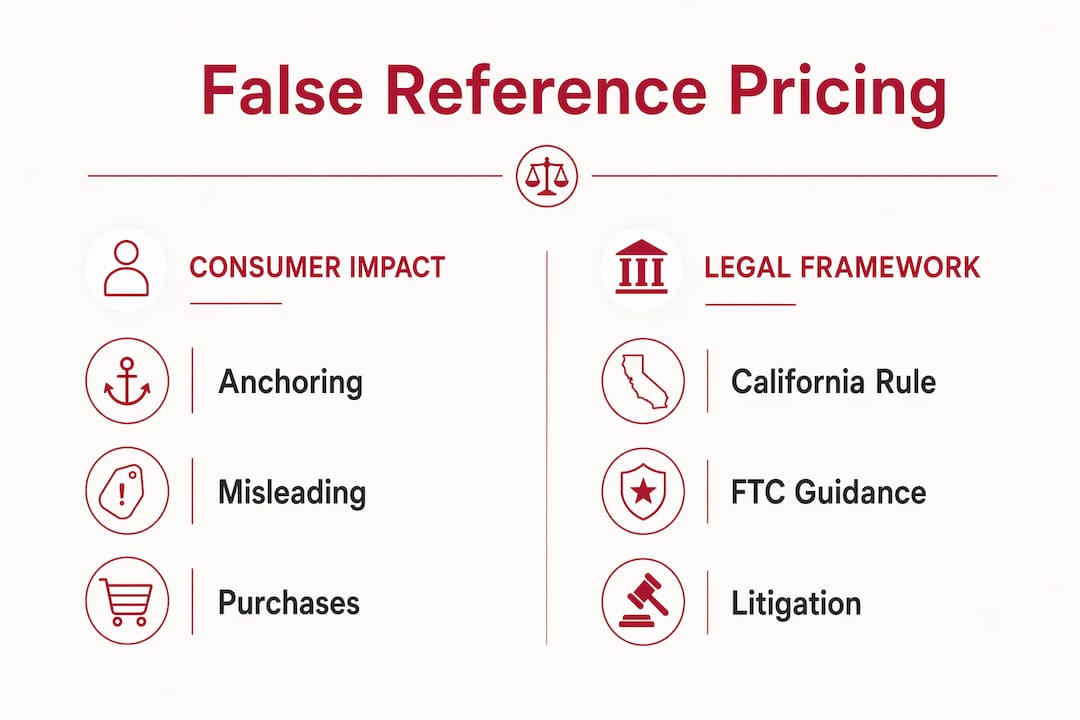
You see it constantly: a jacket listed at $200 $89, a mattress “compared at $1,400” selling for $699, a flash sale where the “regular price” has never actually applied. These formats go by several names — “was/now” pricing, “compare at” labels, strike-through pricing, and perpetual promotions. The common thread is a reference price that does not reflect reality.
Why does this work on consumers? Because people use reference prices as anchors. When you see $200 crossed out, your brain treats $89 as a bargain even if the item has never sold for a dollar over $90. Regulators care about this because the deception is invisible to the buyer at the point of purchase. Consumers rarely verify historical prices, and retailers know it.
A few common scenarios illustrate the problem. An online retailer lists a blender at a “regular price” of $150 but has only ever sold it at $79. A department store runs a “50% off” sale where the reference price was set artificially high three weeks before the promotion launched. A furniture chain advertises “compare at” prices that reflect a manufacturer’s suggested retail price no one actually pays. Each of these can trigger liability in California.

California’s 90-day rule and the statutes that back it up
California has the most specific false reference pricing statute in the country. Under Business and Professions Code §17501, a former price used in advertising must have been the prevailing market price within the three months immediately before the advertisement. If the retailer wants to reference a price older than 90 days, the ad must clearly state when that prior price applied.
That 90-day benchmark is not a guideline. California courts and enforcement agencies apply it strictly, and relying on a generic “reasonable time” standard — the kind the FTC uses — is often insufficient in California cases.
How plaintiffs plead California claims
Most California false reference pricing lawsuits stack three causes of action:
- Bus. & Prof. Code §17500 (False Advertising Law): Prohibits any advertising that is untrue or misleading. A fictitious “was” price qualifies.
- Bus. & Prof. Code §17200 (Unfair Competition Law): Covers unlawful, unfair, or fraudulent business acts. Violating §17501 is itself an unlawful act under §17200.
- Civil Code §1750 et seq. (Consumers Legal Remedies Act): Prohibits deceptive representations about price reductions. The CLRA allows actual damages, punitive damages, injunctive relief, and attorney’s fees.
Class actions are the dominant vehicle. Because each individual consumer’s loss may be small, plaintiffs aggregate claims across thousands of transactions. California’s favorable class certification standards and the CLRA’s fee-shifting provision make the state a preferred venue for these suits.
| Statute | Standard | Remedy |
|---|---|---|
| Bus. & Prof. Code §17501 | Former price must be prevailing market price within 90 days | Establishes the violation; supports §17200 and §17500 claims |
| Bus. & Prof. Code §17500 | No untrue or misleading advertising | Injunctive relief, restitution |
| Bus. & Prof. Code §17200 | No unlawful, unfair, or fraudulent business acts | Injunctive relief, restitution, disgorgement |
| Civil Code §1750 et seq. (CLRA) | No deceptive price-reduction representations | Actual damages, punitive damages, attorney’s fees |
Remedies in California typically include restitution of the price premium consumers paid based on the false discount, injunctive relief requiring corrected pricing, and attorney’s fees under the CLRA. In class actions, restitution can aggregate into the millions even when individual damages are modest. Retailers also face the risk of a court-ordered pricing audit as part of injunctive relief, which is operationally disruptive regardless of the dollar amount.
How federal law and FTC guidance compare to California’s rules
The FTC’s authority over deceptive pricing comes from Section 5 of the FTC Act, which prohibits unfair or deceptive acts or practices in commerce. The agency has published the Guides Against Deceptive Pricing (16 C.F.R. Part 233), which set out the “bona fide prior price” standard: a reference price is legitimate only if the item was openly and actively offered for sale at that price for a reasonably substantial period.
The FTC standard is deliberately flexible. “Reasonably substantial” is not defined by a fixed number of days. That flexibility gives the FTC room to pursue egregious cases while leaving some ambiguity for retailers. California’s 90-day rule eliminates that ambiguity entirely.
“A former price is not necessarily fictitious just because no sales were made at the advertised price. If the price is the actual, bona fide price at which the article was offered to the public on a regular basis for a reasonably substantial period of time, it may be used in a former price comparison.” — FTC Guides Against Deceptive Pricing, 16 C.F.R. § 233.1
| Dimension | FTC Standard | California §17501 |
|---|---|---|
| Time benchmark | “Reasonably substantial period” — no fixed days | 90 days (three months) — fixed statutory rule |
| Sales required | Active offer sufficient; actual sales not required | Prevailing market price required |
| Enforcement | FTC civil penalties, consent orders, injunctions | Private suits, AG enforcement, class actions |
| Private right of action | No direct private right under FTC Act | Yes — via §17200, §17500, CLRA |
| Penalty exposure | Up to $53,088 per violation | Restitution, disgorgement, statutory damages |
The FTC’s 2025 rulemaking expanded its tools to target hidden mandatory fees — so-called drip pricing — in specific sectors. Regulators treat undisclosed mandatory charges as deceptive when they materially change the advertised price. For retailers operating nationally, that means the FTC can act even when California’s 90-day rule is not technically triggered.
FTC enforcement works through consent orders and civil penalty actions, not private lawsuits. A consumer cannot sue directly under the FTC Act. That is why California’s private right of action under §17200 and the CLRA is so significant: it puts enforcement in the hands of plaintiffs’ attorneys, not just regulators.
How consumers and plaintiffs bring false reference pricing claims
The typical California false reference pricing lawsuit begins with a named plaintiff who purchased a product relying on a “was/now” or “compare at” price. The complaint alleges violations of §17500, §17200, and the CLRA, and seeks class certification on behalf of all California consumers who bought the same product during the relevant period.
Damages are usually framed as the “price premium” — the difference between what consumers paid and what they would have paid absent the deceptive reference price. Plaintiffs use expert economists to model this premium across the class. Restitution under §17200 is measured by the amount the retailer received that it would not have received but for the unlawful conduct.
Evidence sequence for litigation
- Archived product pages: Capture the product listing as it appeared during the purchase period, including the reference price and sale price. The Wayback Machine and commercial archiving tools are standard starting points.
- Screenshots with timestamps: Take screenshots at the time of discovery and preserve the metadata. Courts look for contemporaneous evidence, not reconstructions.
- Receipts and order confirmations: These establish the actual purchase price and date, anchoring the damages calculation.
- SKU-level sales and promotion logs: Pricing history at the SKU level shows whether the product ever actually sold at the reference price during the 90-day window.
- Internal pricing memos and marketing materials: Emails or documents discussing how the “regular” price was set can be decisive. A memo showing the reference price was inflated to create a larger discount is often the strongest evidence in the case.
- Witness statements or store communications: Customer service records, chat logs, and employee statements can corroborate that the reference price was not a genuine selling price.
Defenses retailers raise
Retailers most often argue that the reference price was a bona fide prior price, that any error was clerical and short-lived, or that no consumer was actually harmed because the product was competitively priced regardless. Courts treat these defenses skeptically when the retailer cannot produce documentation. Retailers frequently lose when they rely on short-lived fabricated prior prices or lack records showing actual sales at the reference price for a meaningful period.
The statute of limitations for UCL and false advertising claims in California is generally four years. CLRA claims carry a three-year limitations period. Plaintiffs’ counsel typically send a CLRA demand letter 30 days before filing, giving retailers a narrow window to cure.
How retailers can reduce litigation risk right now
The single most effective thing a retailer can do is maintain time-stamped pricing history at the SKU level. If you cannot prove when a price was set, how long it was active, and what actual sales occurred at that price, you cannot defend a §17501 claim.
Concrete compliance steps:
- Document every price change with a timestamp, the person who authorized it, and the reason for the change. A pricing-change log is not optional in California — it is your primary defense.
- Require a meaningful period at the reference price before using it in a promotion. California’s 90-day rule is the floor; building in a buffer beyond 90 days reduces risk further.
- Disclose sale dates when the prior price is older than 90 days. The statute allows use of older prices if the ad clearly states when that price applied. Use this option rather than omitting the date.
- Show full final prices early in the checkout flow. Mandatory fees that appear only at checkout can trigger FTC drip-pricing enforcement independently of the reference price issue.
- Archive product pages automatically. Set up automated archival of product listings at each price change. Commercial tools can capture page states with timestamps that are harder to challenge than manual screenshots.
- Train your promotions team on the 90-day rule before any sale campaign launches. Executive sign-off for promotions that use former prices adds an accountability layer that courts notice.
Pro Tip: If you discover a problematic listing already live, take it down immediately, correct the pricing, and retain all audit logs from the moment of discovery. Voluntary correction before litigation begins is a meaningful mitigating factor, but only if you can document the timeline.
For retailers navigating the intersection of pricing disclosures and broader contractual obligations, understanding when to use non-disclosure agreements for internal pricing strategy documents can also reduce exposure in discovery.
What to collect before you file: an evidence checklist
Evidence preservation starts the moment you suspect a pricing violation, not when you hire an attorney. Here is what consumers and counsel should collect.
Screenshots with timestamps are the foundation of any pricing claim. Capture the full product page, including the URL, the reference price, the sale price, and any promotional language. Most browsers display the date and time in the screenshot metadata. Take multiple captures across different days if the listing remains live.
Receipts and order confirmations establish your actual purchase price and the exact date of the transaction. Digital receipts are preferable because they carry embedded metadata. Print copies as backup.
Archived web pages from services like the Wayback Machine or archive.today can show what a product page looked like before you discovered the issue. These are particularly useful when a retailer has already corrected the listing. Pull archives covering the full 90-day window before the promotion.
Ad campaign logs and promotional emails document how the retailer communicated the sale. Marketing emails with “was/now” pricing are direct evidence of the deceptive claim and often include send dates that anchor the timeline.
SKU and pricing history exports are typically obtained through formal discovery, but consumers can sometimes request them through a preservation letter before filing. These records show whether the product ever actually sold at the reference price during the relevant period.
Witness statements and store communications include customer service chat logs, email responses from the retailer, and any in-store signage you photographed. If a store employee confirmed the “regular” price in writing, preserve that exchange.
For preservation, save everything in at least two locations, note the chain of custody for any records obtained from third parties, and send a formal preservation letter to the retailer as soon as litigation is contemplated. That letter triggers a legal hold obligation and can support sanctions if the retailer later destroys records. Academic and policy research also recommends disclosure of recent actual selling prices as the clearest remedy, which means pricing history records are increasingly central to both enforcement and litigation.
Key Takeaways
California’s 90-day rule under §17501 is the strictest false reference pricing standard in the country, and documentation is the difference between a viable defense and a losing one.
| Point | Details |
|---|---|
| California’s 90-day rule | Any advertised former price must reflect the prevailing market price within the three months before the ad runs. |
| Federal FTC standard | The FTC requires a “bona fide” prior price offered for a reasonably substantial period; no fixed day count, but civil penalties can reach up to $53,088 per violation. |
| Evidence preservation | Consumers should screenshot and timestamp pricing claims immediately; attorneys need SKU-level sales data and archived pages to prove the reference price was fictitious. |
| Retailer compliance | Maintain time-stamped pricing logs, require a meaningful period at the reference price, and disclose sale dates when the prior price is older than 90 days. |
| Legal help | Javitchlawoffice handles consumer class actions and deceptive pricing claims in California and can evaluate your case at intake. |
Why enforcement is accelerating and what it means for you
The volume of strike-through and reference pricing class actions in California has grown sharply over the past several years, and the trend is not slowing. Plaintiffs increasingly assert multiple state-law claims and aggregate them as class actions, particularly where a statutory rule like California’s creates a clear, provable standard. That combination — a fixed 90-day benchmark plus a private right of action — makes California the most plaintiff-friendly venue in the country for these cases.
What I find underappreciated in most coverage of this area is how decisive documentation is, not just for retailers defending claims, but for consumers and counsel building them. The cases that settle quickly and favorably for plaintiffs are almost always the ones where the plaintiff’s attorney walks in with archived product pages, SKU-level pricing exports, and an internal email showing the reference price was set artificially high. The cases that drag on are the ones where the evidence is thin and the retailer can plausibly argue the prior price was genuine.
Regulators are also paying closer attention to the intersection of reference pricing and hidden fees. The FTC’s 2025 rulemaking on drip pricing signals that enforcement is expanding beyond the classic “was/now” format to cover any pricing presentation that materially misleads consumers about the final cost. International regulators, including those documented in APEC enforcement reports, are moving in the same direction. For California retailers operating nationally, that means the compliance bar is rising on two fronts simultaneously.
The practical implication: if you are a retailer and your pricing team cannot produce a 90-day pricing log for any current promotion within 24 hours of a request, you have a litigation risk that is larger than you probably realize.
Javitchlawoffice can evaluate your false pricing claim
If you are a California consumer who purchased a product based on a “was/now” or “compare at” price that turned out to be fictitious, or a retailer trying to understand your exposure before a demand letter arrives, Javitchlawoffice is equipped to help. The firm’s consumer class action practice covers deceptive pricing claims under §17200, §17500, and the CLRA, and the firm handles both individual and class-level matters.
Consultations cover the strength of your evidence, the applicable statutes, and whether your situation warrants individual litigation or class treatment. For consumers, many pricing cases are handled on a contingency basis, meaning no upfront legal fees. For retailers, the firm can assess current pricing practices and identify exposure before a complaint is filed.
What to bring to your intake: screenshots of the pricing claim with timestamps, your receipt or order confirmation, any archived product pages you have saved, and any communications with the retailer about the price. The more of the evidence checklist above you can produce at intake, the faster the evaluation moves.
Javitchlawoffice is based in California and handles consumer protection matters with the jurisdictional depth the state’s complex statutory framework requires. Contact the firm directly to schedule a consultation. All inquiries are confidential and subject to conflict screening before any engagement.
This article is general legal information, not legal advice. Confirm how current statutes apply to your specific situation with a qualified attorney.
Primary sources and further reading
The sources below are organized by audience. Consumers should start with the FTC’s own guidance. Attorneys need the statutory text and academic research. Retailers benefit most from the practitioner alerts.
For consumers:
- FTC Deceptive Pricing Guides — the FTC’s official page on deceptive pricing rules, including the Guides Against Deceptive Pricing (16 C.F.R. Part 233).
- FTC Deceptive Pricing Rules, Tactics, and Penalties — LegalClarity — plain-English summary of FTC enforcement tools and civil penalty exposure.
For attorneys and legal professionals:
- California Business and Professions Code §17501 — the primary California statute establishing the 90-day former price rule.
- California Business and Professions Code §§17200 and 17500 — the Unfair Competition Law and False Advertising Law statutory text.
- Competition and the Regulation of Fictitious Pricing — Journal of Marketing (SagePub) — peer-reviewed academic analysis of fictitious pricing regulation and disclosure remedies.
- What Counts as Deceptive Pricing in E-Commerce? — Revision Legal — practitioner analysis of bona fide prior price requirements and evidence standards.
- Javitchlawoffice California 90-Day Price Rule explainer — firm-authored analysis of §17501 and practical compliance steps.
For retailers:
- One Strike and You’re Out: Strikethrough Pricing and Perpetual Promotion Claims Surge — Buchanan Ingersoll & Rooney — practitioner alert on litigation trends and compliance pitfalls for retailers using strike-through pricing.
- APEC Misleading Pricing and Discounts: Best Practices and Policy Recommendations — comparative international enforcement approaches, useful for retailers operating across multiple markets.
- eCFR 16 C.F.R. Part 233 — FTC Guides Against Deceptive Pricing — the full regulatory text of the FTC’s deceptive pricing guides.
Recommended
- California’s 90 Day Price Rule: Fighting Deceptive Pricing Practices | Javitch Law Office
- Legal Resources & Blog | Javitch Law Office
- Legal Resources & Blog | Javitch Law Office
- Legal Resources & Blog | Javitch Law Office
Think You Were Misled by a Fake “Sale” Price?
If a retailer advertised an inflated “regular,” “was,” or “compare at” price to make a discount look bigger than it was, you may have a claim for restitution under California's Unfair Competition Law, False Advertising Law, and the Consumer Legal Remedies Act. These cases are often brought as class actions because the same misleading label affects many shoppers at once.
Save your receipt and screenshots of the advertised pricing, then contact Javitch Law Office for a free, confidential case review. There is no fee unless we recover.
Related reading: California's 90-Day Price Rule explained.
FAQ
Can I sue a retailer for a fake “was” price?
Yes. Under California Business and Professions Code §17501, a retailer can only advertise a former price if the item was actually offered at that price within the last 90 days. A fabricated “was” price can support claims under the Unfair Competition Law, False Advertising Law, and Consumer Legal Remedies Act.
What evidence should I save?
Screenshots of the product page showing the “was” and sale prices, the receipt or order confirmation, any promotional emails or ads, and price-history snapshots from the Wayback Machine or price-tracking sites.
What can I recover in a false reference pricing lawsuit?
Consumers may be entitled to restitution of the amount paid, injunctive relief stopping the practice, and in some cases statutory damages. Because these violations usually affect many buyers, they are often pursued as class actions.
Does the FTC Act apply to fake “compare at” prices?
Yes. The FTC's Guides Against Deceptive Pricing prohibit advertising a “regular” or “compare at” price unless it reflects a genuine, substantial, and recent price at which the item was offered for sale.
How do I start a claim?
Contact Javitch Law Office for a free case review. We handle consumer protection and false advertising cases on a contingency-fee basis, so there is no upfront cost to you.