
In California, you generally have 300 calendar days from the date of the alleged discrimination to file a charge with the U.S. Equal Employment Opportunity Commission. That’s longer than the federal baseline of 180 calendar days that applies in states without their own anti-discrimination enforcement agency. California has one, the California Civil Rights Department, which triggers the extended window automatically.
A few things to know upfront:
- Standard federal deadline: 180 calendar days from the discriminatory act
- California deadline: 300 calendar days, due to state agency enforcement
- Harassment and hostile work environment: deadline runs from the last act of harassment, not the first
- Equal Pay Act claims: different rules apply; you can sue directly in court within 2 years (or 3 years for willful violations) of the last discriminatory paycheck
- Age discrimination: the 300-day extension applies only if a state law and state agency both cover age discrimination
- Multiple discrete acts: each event has its own deadline clock
How California’s 300-day EEOC filing deadline actually works
The 300-day window sounds straightforward, but the details trip people up. Every day counts, including weekends and federal holidays. The only exception: if your deadline lands on a weekend or federal holiday, it shifts to the next business day.
| Claim Type | Deadline | Notes |
|---|---|---|
| Standard discrimination (CA) | 300 calendar days | State agency enforcement triggers extension |
| Standard discrimination (other states) | 180 calendar days | No qualifying state agency |
| Age discrimination (CA) | 300 calendar days | Only if state law and state agency both apply |
| Hostile work environment | 300 days from last act | Earlier acts still investigated |
| Equal Pay Act | 2 years (3 if willful) | No EEOC charge required; file directly in court |
| Multiple discrete acts | Per-act deadline | Each event starts its own clock |
When multiple discriminatory events occur, each one carries its own deadline. Say your employer demoted you in january and fired you in december of the same year. If you file a charge the day after termination, only the termination claim is timely unless you also filed within 300 days of the demotion. The EEOC will investigate what’s timely and set aside what isn’t.

Ongoing harassment is the major exception. Under the Supreme Court’s ruling in National Railroad Passenger Corp. v. Morgan, a hostile work environment claim stays alive as long as at least one act of harassment falls within the filing period. The EEOC can then look at the full pattern, including earlier incidents that would otherwise be time-barred.
How to file an EEOC charge in California
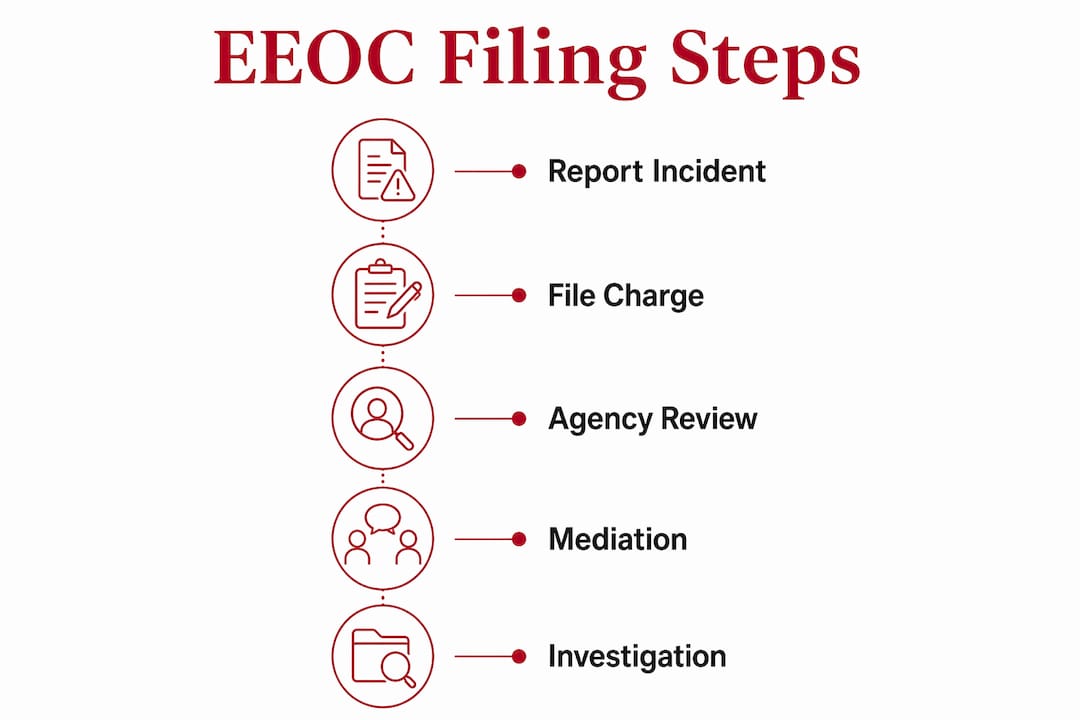
Filing a charge is a formal legal step, not just a complaint. Here’s how the process works:
- Start with the EEOC Public Portal: Submit an online inquiry at eeoc.gov. You’ll be asked to schedule a telephone, video, or in-person interview at one of the EEOC’s 53 offices nationwide.
- Complete the intake interview: This is where your charge takes shape. The official filing date is set when the EEOC formally receives your signed charge, not when you submit the initial inquiry.
- Watch the 60-day threshold: If you have 60 days or fewer left to file, the EEOC Public Portal gives special expedited instructions for submitting quickly.
- California EEOC offices: Los Angeles, San Diego, Oakland, and Fresno all have field offices. Find the nearest one by entering your zip code on the EEOC website.
- After filing: The EEOC notifies your employer within 10 days. Investigations average about 10 months, though mediation can resolve cases in under 3 months.
Pro Tip: If your deadline is approaching fast, call 1-866-408-8075 directly to request an immediate interview. Do not wait for the online portal to schedule you — walk into a local office if you have to.
You can file a charge while still employed. The EEOC’s confidentiality rules and anti-retaliation protections under Title VII apply from the moment you file.

What happens if you miss the EEOC filing deadline
Missing the deadline is almost always fatal to your federal discrimination claim. The consequences are concrete:
- Claim dismissal: The EEOC is required by law to close an untimely charge and notify your employer that one was filed, even if it can’t help you.
- Loss of right to sue: Without a timely EEOC charge, you cannot file a federal lawsuit under Title VII, the ADA, or the ADEA.
- No remedy for lost wages or damages: Every form of relief, back pay, reinstatement, compensatory damages, disappears with the claim.
- Internal processes don’t save you: Filing a union grievance, going through HR, or pursuing arbitration does not pause the EEOC clock. The deadline keeps running regardless of what else you’re doing to resolve the dispute.
The one narrow path: equitable tolling. Courts can, in rare cases, toll the deadline when an employer actively misled you about your rights or when extraordinary circumstances prevented filing. This is not a reliable fallback. Treat the 300-day window as absolute.
Local California EEOC offices and legal consultation resources
California claimants have access to federal offices, local government resources, and private legal counsel. Here’s how the main options compare:
| Provider | Office Location | Service Type | Consultation Available | Rating |
|---|---|---|---|---|
| U.S. Equal Employment Opportunity Commission | Los Angeles, San Diego, Oakland, Fresno | Federal charge filing, investigation, mediation | Phone, video, in-person | 2.5★ (30 reviews) |
| Equal Employment Opportunity Commission | Statewide California offices | State-level enforcement, charge processing | Scheduled intake interviews | 2.5★ (30 reviews) |
| US Equal Employment Opportunity | California-wide | Advocacy, community support, referrals | Community outreach | 2.5★ (30 reviews) |
| Javitch Law Office | San Mateo, CA (serves California statewide) | Private legal representation, civil rights litigation | Free consultation | 5★ (7 reviews) |
| Santa Clara Equal Opportunity | Santa Clara County, CA | Local government enforcement, county-level support | Direct county office contact | 5★ (1 review) |
The U.S. Equal Employment Opportunity Commission’s California offices handle the full federal charge process, from intake through investigation and potential litigation referral. They are the mandatory first stop for most discrimination claims under Title VII, the ADA, and the ADEA.
Santa Clara Equal Opportunity serves claimants specifically within Santa Clara County, offering local government enforcement that can complement a federal EEOC charge. For county residents, it’s worth contacting them alongside the federal office.
Javitch Law Office operates out of San Mateo and serves clients across California. As a private civil rights firm, it offers something the government offices don’t: personalized legal strategy, attorney representation throughout the EEOC process, and direct advocacy if your case proceeds to litigation.
Expert legal guidance from Javitch Law Office on EEOC deadlines
Javitch Law Office focuses on employment discrimination claims in California, including cases involving racial discrimination, antisemitic bias, and hostile work environment claims. The firm’s approach is built around one-on-one case evaluation, which matters when deadline calculations get complicated.
Here’s what their guidance typically covers for EEOC claimants:
- Deadline verification: Confirming whether the 180-day or 300-day window applies to your specific claim and employer
- Hostile work environment analysis: Identifying whether the Morgan doctrine extends your filing window based on the pattern of conduct
- Equal Pay Act strategy: Evaluating whether to file an EEOC charge under Title VII, pursue an EPA lawsuit directly, or both
- Documentation review: Assessing what evidence you have and what gaps need to be filled before the charge is filed
- Post-filing representation: Guiding you through the EEOC investigation and any subsequent workplace discrimination litigation
The firm offers free initial consultations. For anyone unsure whether their situation qualifies or how much time they have left, that conversation costs nothing and could preserve rights worth far more.
Javitchlawoffice: a different kind of help for California claimants
The EEOC offices and Santa Clara Equal Opportunity are government resources. They process charges, investigate complaints, and sometimes mediate. What they don’t do is represent you.
Javitchlawoffice fills that gap. As a California civil rights firm, it handles the legal strategy that government offices can’t provide: building your case, advising on whether to pursue federal or state remedies, and representing you if the EEOC process doesn’t resolve your claim. For claimants facing a tight deadline or a complex fact pattern, having an attorney involved from the start, not after the EEOC closes your file, changes the outcome. You can reach Javitchlawoffice for a free case evaluation and get a clear answer on where you stand before the clock runs out.
Key Takeaways
California claimants have an extended filing period to file an EEOC charge, but missing the filing deadline almost always ends the case permanently, making early legal advice the most protective step you can take.
| Point | Details |
|---|---|
| California deadline | 300 calendar days from the discriminatory act, extended from the federal 180-day baseline |
| Harassment exception | Deadline runs from the last act; earlier incidents can still be investigated under the Morgan ruling |
| Equal Pay Act | File directly in court within 2 years (3 for willful violations); no EEOC charge required |
| Internal processes don’t toll | Grievances, arbitration, and HR complaints do not pause the EEOC filing clock |
| Javitchlawoffice | Offers free consultations for California claimants to verify deadlines and build discrimination cases before time runs out |
Recommended
- FOIA Requests: Accessing Government Records in California and Federal Agencies | Javitch Law Office
- How to Sue for Public Records: A Guide to FOIA and State Records Litigation | Javitch Law Office
- Antisemitic & Racial Discrimination Attorneys | Javitch Law Office
- California Public Records Act Lawyer: Enforcing Your Right to Government Transparency | Javitch Law Office