
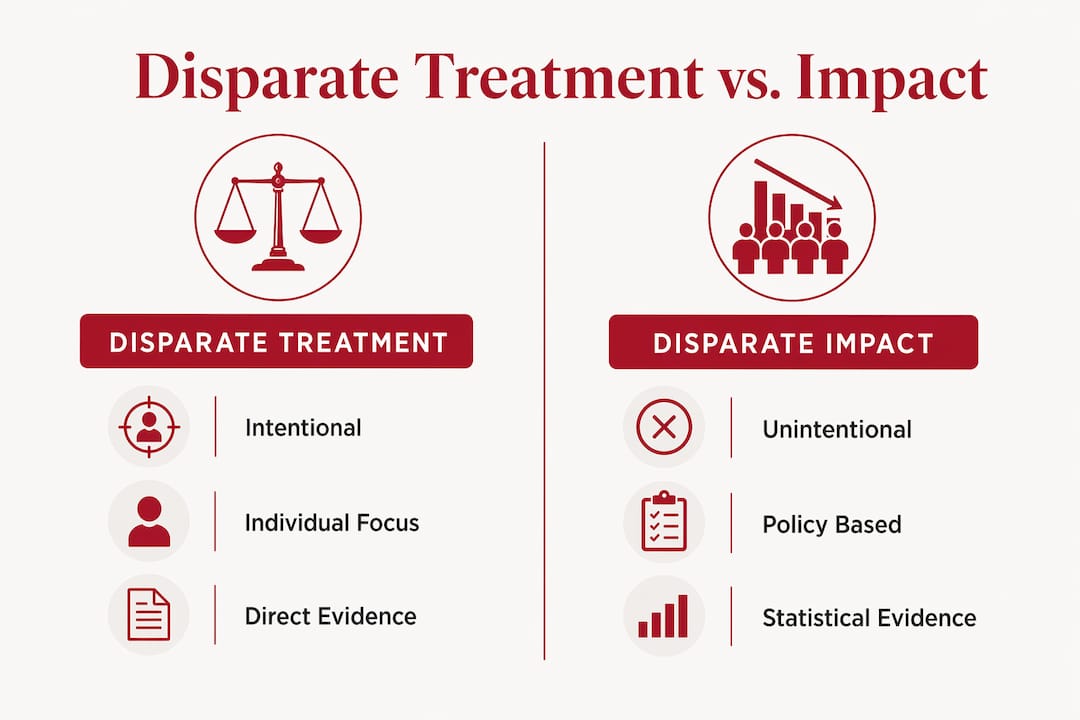
The core difference between disparate treatment and disparate impact discrimination comes down to one word: intent. Disparate treatment is intentional. An employer treats someone worse because of their race, sex, religion, or national origin. Disparate impact is unintentional. A neutral policy produces outcomes that disproportionately harm a protected group, regardless of what the employer meant to do.
Both theories arise under Title VII of the Civil Rights Act of 1964, and both are recognized under California’s Fair Employment and Housing Act (FEHA). Here is how they compare at a glance:
- Disparate treatment: Intentional discrimination; employer treats protected individuals less favorably; proof of discriminatory motive required
- Disparate impact: No intent required; neutral policy causes disproportionate harm to a protected group; statistical and causal evidence required
- Key legal difference: Intent is the dividing line; disparate treatment demands proof of motive, disparate impact focuses on effect
- Remedies: Disparate treatment allows compensatory and punitive damages; disparate impact is generally limited to injunctive relief under Title VII.
- 2026 update: The DOJ issued an opinion raising the evidentiary burden for disparate impact plaintiffs significantly
What is disparate treatment and how do you prove it?
Disparate treatment occurs when an employer treats an individual less favorably than similarly situated colleagues because of a protected characteristic. Courts in cases like DeJung v. Superior Court have defined it plainly as “intentional discrimination on prohibited grounds.”
Proving it does not require a smoking gun. Courts and the EEOC recognize that direct evidence of bias is rare, so discriminatory motive can be inferred from how similarly situated employees of different backgrounds were treated in comparable situations. A Black employee denied a promotion while a white colleague with the same performance record receives it is a textbook example.
The standard legal framework for individual disparate treatment claims is the McDonnell Douglas burden-shifting test, established in McDonnell Douglas Corp. v. Green (1973):
- The employee establishes a prima facie case of discrimination
- The burden shifts to the employer to articulate a legitimate, nondiscriminatory reason
- The employee must then show that reason is pretextual
California’s FEHA mirrors this structure but adds state-specific enforcement through the Civil Rights Department (formerly DFEH), giving California workers an additional avenue beyond the EEOC.
Pro Tip: Document every instance where a similarly situated colleague of a different background received better treatment. Courts compare employees in the same role, with similar qualifications and performance records. The more comparators you can identify, the stronger your inference of discriminatory motive.
Statistical evidence can support a disparate treatment claim, but it does not stand alone. Statistics showing that an employer has never promoted a Black employee into management, for instance, help establish a pattern. They are evidence of motive, not proof by themselves.
How disparate impact discrimination works under current law
Disparate impact targets policies that look neutral on paper but produce discriminatory outcomes in practice. No intent is required. A company that requires all applicants to pass a written aptitude test may not intend to exclude any group, but if that test disproportionately screens out Hispanic applicants without being tied to actual job performance, it can violate Title VII.
The legal framework for proving a disparate impact claim involves three steps:
- Step 1: The plaintiff identifies the specific policy or practice causing the adverse effect and shows it produces a statistically significant disparity for a protected group
- Step 2: The burden shifts to the employer to show the practice is job-related and consistent with business necessity
- Step 3: If the employer meets that burden, the plaintiff can still prevail by identifying an equally effective alternative practice with less discriminatory impact
The historic EEOC 80% rule served as a statistical benchmark: if a protected group is selected at a rate below 80% of the most-selected group, that flags a potential disparate impact. That benchmark is now under serious legal pressure.
Legal shift in 2026: The DOJ issued an opinion concluding that EEOC’s prior disparate impact guidelines are unconstitutional. Under this new standard, statistical evidence alone no longer suffices. Plaintiffs must prove the specific practice directly caused the disparity and must identify a viable, equally effective alternative with less discriminatory impact.
Employers now have more room to defend practices like background checks, aptitude tests, and credential requirements by showing they serve a rational business purpose. The business-necessity bar, per the DOJ opinion, is not a high one: the practice only needs to be “reasonable, useful, or helpful” for a valid business goal.

Remedies and enforcement: what each claim actually gets you
The practical difference between these two theories shows up most clearly in what a successful plaintiff can recover.
Disparate treatment claims allow for the full range of Title VII remedies, including compensatory damages for emotional distress and financial harm, and punitive damages when the employer acted with malice or reckless indifference. Under California’s FEHA, those damages can be substantial, and the state does not cap punitive damages the way federal law does for smaller employers.
Disparate impact claims are more limited:
- Primary remedy: Injunctive relief, meaning a court order requiring the employer to change the policy
- Back pay: Available in some circumstances, but not guaranteed
- Compensatory and punitive damages: Generally not available for disparate impact findings under Title VII
- California FEHA: Provides somewhat broader remedies at the state level, which is one reason California plaintiffs often pursue state claims alongside federal ones
The EEOC enforces both theories, but the agency applies different investigative standards. For disparate treatment, investigators look for comparative evidence and direct statements. For disparate impact, they analyze workforce data and policy design. Since the June 2026 DOJ opinion, EEOC’s ability to pursue disparate impact claims aggressively has been constrained, shifting more of the enforcement weight to state agencies like California’s Civil Rights Department.
Real-world examples of each discrimination type
Concrete scenarios make the legal distinction easier to grasp.
Disparate treatment example: A hiring manager at a Los Angeles tech firm receives two equally qualified resumes. She calls back the applicant with a traditionally white-sounding name and passes on the applicant with an African name, without any other distinguishing factor. That is intentional discrimination based on perceived race. The motive can be inferred from the disparity in treatment between similarly situated applicants.

Disparate impact example: A Bay Area logistics company requires all warehouse supervisors to hold a four-year college degree. The job involves scheduling and safety compliance, neither of which requires a degree. That requirement disproportionately screens out Latino and Black applicants, who hold four-year degrees at lower rates than white applicants in the relevant labor market. The policy is facially neutral but produces a discriminatory effect. Under California’s FEHA, the employer would need to show the degree requirement is genuinely tied to job performance.
Pro Tip: If you believe a workplace policy is screening you or your colleagues out at a disproportionate rate, document the demographics of who applies versus who gets hired or promoted. That data forms the foundation of a disparate impact claim.
Housing discrimination follows the same framework. A landlord who refuses to rent to a family because of their national origin is engaging in disparate treatment. A landlord who applies a strict minimum income requirement that disproportionately excludes Section 8 voucher holders, who are predominantly people of color, may face a disparate impact challenge under California’s housing laws.
What 2026 legal developments mean for your case
The DOJ’s June 2026 opinion represents the most significant doctrinal shift in disparate impact law in decades. The Office of Legal Counsel concluded that EEOC’s prior guidelines were unconstitutional because they imposed liability based on unequal outcomes alone, without requiring any showing that the employer likely intended to discriminate.
Key practical implications for both sides:
- For plaintiffs: You must now connect the specific challenged practice to the specific disparity. A general statistical gap across the workforce is not enough. You also need to identify a concrete, equally effective alternative the employer could have used.
- For employers: Standard tools like aptitude tests, background checks, and credential requirements are presumptively job-related. You only need to show the practice rationally serves a valid business purpose, not that it is the only possible approach.
- For California workers: State law under FEHA still provides independent protections. California courts are not bound by the DOJ’s federal constitutional opinion, and the Civil Rights Department continues to enforce state disparate impact standards.
Courts now look at disparate impact claims as an evidentiary tool for identifying likely intentional discrimination, not as a standalone liability theory based purely on statistical outcomes. That is a meaningful narrowing of the doctrine.
If you are navigating a discrimination claim in California, the interplay between federal and state law creates real strategic choices. Javitchlawoffice handles both disparate treatment and disparate impact cases across employment, housing, and public accommodations, with particular depth in racial and antisemitic discrimination claims.
Landmark cases that shaped both legal doctrines
The history of these two theories runs through a handful of decisions that every employment discrimination attorney knows cold.
Griggs v. Duke Power Co. (1971) is the foundation of disparate impact law. Duke Power required a high school diploma and passing scores on two aptitude tests for certain jobs. The Supreme Court found these requirements screened out Black applicants at a higher rate and were not tied to job performance. The Court held that Title VII “proscribes not only overt discrimination, but also practices that are fair in form, but discriminatory in operation.” That sentence created the disparate impact doctrine.
McDonnell Douglas Corp. v. Green (1973) gave disparate treatment law its procedural backbone. The burden-shifting framework from that case still governs individual disparate treatment claims today, more than 50 years later.
International Brotherhood of Teamsters v. U.S. (1977) established that statistical evidence of workforce composition can support an inference of discriminatory motive in disparate treatment cases, particularly in pattern-and-practice claims.
Ricci v. DeStefano (2009) illustrated the tension between the two theories directly. New Haven discarded firefighter promotion exam results because of their racial disparate impact on Black and Hispanic officers. White officers who passed sued for disparate treatment. The Supreme Court ruled for the white officers, holding that an employer may only make a race-based decision to avoid disparate impact liability if there is a “strong basis in evidence” that the challenged practice is not job-related. Avoiding one theory cannot justify violating the other.
The Civil Rights Act of 1991 codified the disparate impact framework into Title VII after Wards Cove Packing Co. v. Atonio (1989) had weakened it, restoring the burden-shifting structure and making clear that plaintiffs must identify specific practices rather than pointing to general workforce imbalances. Understanding class action litigation trends helps contextualize how these doctrines play out at scale in modern employment cases.
Key Takeaways
Disparate treatment requires proof of intentional discrimination, while disparate impact focuses on the discriminatory effect of neutral policies, and the 2026 DOJ opinion has significantly raised the evidentiary bar for impact claims.
| Point | Details |
|---|---|
| Intent is the dividing line | Disparate treatment requires discriminatory motive; disparate impact does not require intent at all. |
| Proof standards differ sharply | Disparate treatment uses the McDonnell Douglas burden-shifting test; disparate impact requires specific causation and a viable alternative practice. |
| Remedies are not equal | Disparate treatment allows compensatory and punitive damages; disparate impact is generally limited to injunctive relief under Title VII. |
| 2026 DOJ opinion narrows impact claims | Plaintiffs must now prove the specific practice caused the disparity and identify an equally effective, less discriminatory alternative. |
| California FEHA adds state protections | California law provides independent enforcement and broader remedies beyond federal Title VII standards for both discrimination types. |
Facing discrimination at work or in housing? Javitchlawoffice represents clients across California and nationwide in racial and antisemitic discrimination cases, including both disparate treatment and disparate impact claims. If you believe a policy or a person’s actions have cost you a job, a promotion, or a home because of who you are, a free case evaluation is the right first step. The legal landscape shifted in 2026, and knowing which theory applies to your situation determines everything about how your case is built. Reach out to Javitchlawoffice to find out where you stand.
Recommended
- Fighting Antisemitic and Racial Discrimination in the Workplace | Javitch Law Office
- Antisemitic & Racial Discrimination Attorneys | Javitch Law Office
- When to Hire a Racial Discrimination Lawyer: Protecting Your Workplace Rights | Javitch Law Office
- Jewish Discrimination in the Workplace: Know Your Rights and Legal Options | Javitch Law Office