
For most California merchants, adding a credit card surcharge at checkout is effectively prohibited under state law. California Civil Code § 1748.1 and the broader transparency mandate of SB 478 (effective July 1, 2024) require that any mandatory fee be baked into the advertised price before a customer ever reaches the register. Restaurants received a narrow carve-out under SB 1524, but every other business category must show the full price upfront. If you are a consumer who was charged an undisclosed credit card fee, or a merchant trying to figure out how to stay compliant, this guide covers the statutes, the safe alternatives, the penalties, and when to call an attorney.
This article provides general legal information, not legal advice. Confirm current rules with the California Attorney General or a qualified attorney before making pricing decisions.
Key Takeaways
California’s credit card surcharge rules are among the strictest in the country: the advertised price must include every mandatory fee, and violations carry class-action exposure under the CLRA.
| Point | Details |
|---|---|
| Surcharges are effectively banned | Civil Code § 1748.1 and SB 478 require mandatory fees to be included in the advertised price for consumer transactions. |
| Restaurant exception is narrow | SB 1524 allows restaurants to list certain fees separately, but only with conspicuous pre-order disclosure on menus and digital platforms. |
| Cash discounts are the safe alternative | Offering a lower price for cash or ACH payment is lawful when the card price is the posted baseline. |
| Violations carry class-action risk | The CLRA allows private plaintiffs to recover damages and attorney’s fees, making small per-transaction fees viable for class litigation. |
| Javitchlawoffice handles these cases | The firm evaluates consumer class actions involving deceptive pricing and hidden fees throughout California. |
Table of Contents
- What California law actually says about credit card surcharges
- What merchants can legally do instead of adding a surcharge
- How Visa, Mastercard, and federal rules interact with California law
- Practical compliance checklist for California merchants
- Penalties, enforcement, and class-action risk
- What to do if you were charged an undisclosed credit card fee
- When to consult an attorney about a surcharge dispute
- The real compliance calculus most merchants get wrong
- Javitchlawoffice can help with deceptive pricing and class-action claims
- Primary sources and authoritative references
- Sources
What California law actually says about credit card surcharges
California Civil Code § 1748.1 has long restricted the practice of tacking on a separate fee for credit card payment. SB 478, which took effect July 1, 2024, sharpened that restriction considerably. Under SB 478, amending the Consumer Legal Remedies Act (CLRA), any mandatory fee that a consumer cannot avoid must be included in the advertised or listed price. You cannot show $50 on the shelf tag and then charge $51.75 at checkout because the customer used a Visa.
The California Attorney General’s office treats drip pricing, where fees appear only at the final step of a transaction, as a deceptive practice subject to enforcement. The AG guidance reinforces what the statute says: the price a consumer sees in an ad, on a menu, on a website product page, or on a shelf label must be the price they pay, minus only taxes and certain shipping costs that are genuinely variable and disclosed.
Who is covered: SB 478 applies to consumer transactions. Business-to-business (B2B) contracts can sometimes be structured differently, since the CLRA generally covers goods and services purchased for personal, family, or household use. A commercial invoice between two businesses may have more flexibility, but that flexibility is narrower than many assume, and substance-over-form review means relabeling a fee does not automatically move it outside the statute’s reach.
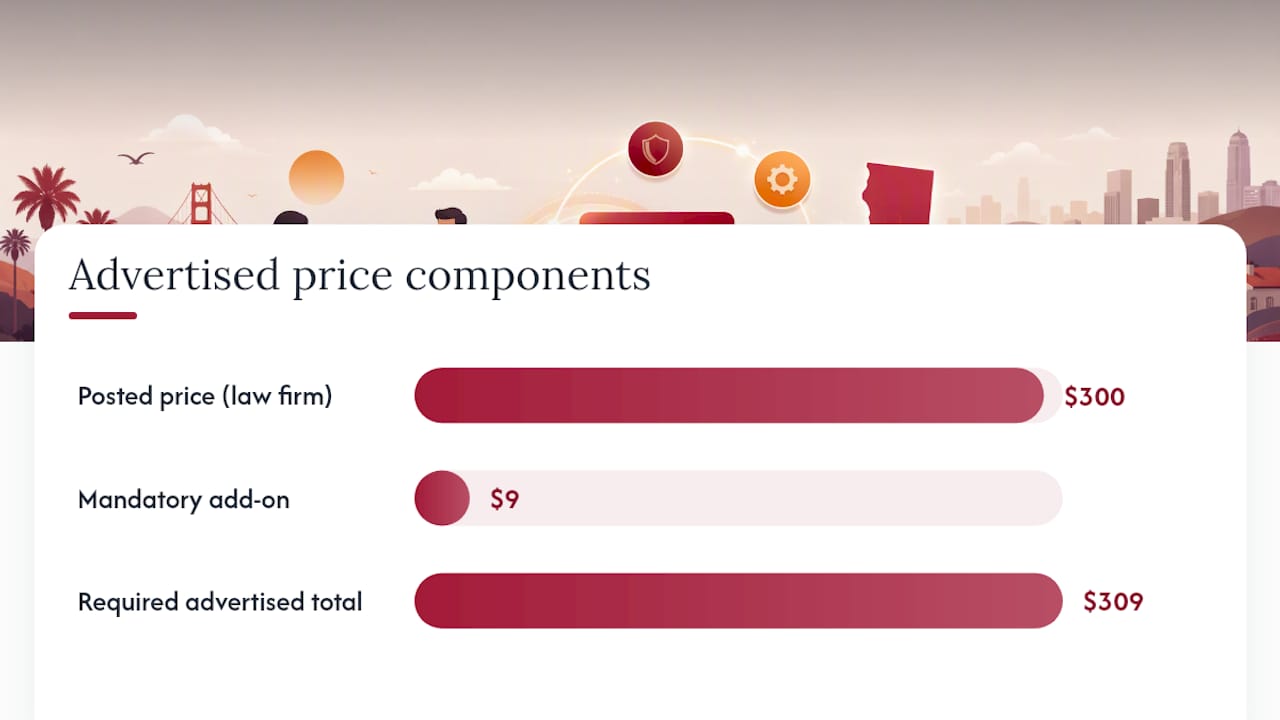
A concrete example: A law firm posts a $300 flat fee for a document review on its website. Under SB 478, that $9 add-on is the problem. The advertised price should have been $309 from the start, or the firm should offer a cash/ACH discount from a $309 base.
- Civil Code § 1748.1 restricts merchants from imposing a surcharge on credit card transactions in consumer sales.
- SB 478 (July 1, 2024) extends the rule to all mandatory fees, not just those labeled “surcharges.”
- The CLRA provides the private enforcement mechanism that makes violations litigable by individual consumers and class plaintiffs.
- The restaurant exception (SB 1524) is real but narrow, discussed in the next section.
Past litigation shaped this landscape too. A Supreme Court docket from 2016 shows that federal courts, including the Ninth Circuit, previously found some state surcharge bans raised First Amendment concerns, which contributed to the shift from outright bans toward transparency-based rules like SB 478.
What merchants can legally do instead of adding a surcharge
Three pricing approaches work under California law. Only one of them, the late-added surcharge, is off the table.
Option 1: Card-inclusive pricing. Set your prices to reflect the cost of accepting credit cards. Every customer pays the same price regardless of payment method. No disclosure gymnastics required. This is the cleanest approach and the one Scherer Smith & Kenny LLP recommends for professional service firms.
Option 2: Cash discount program. Post the card price as your standard price, then offer a lower price for cash or ACH payment. The key is that the card price must be the default advertised price, not a base price with a fee added on top.
Option 3: The restaurant exception (SB 1524). Restaurants may display certain mandatory service fees separately from menu prices, but the exception comes with strict display requirements. The fee must appear conspicuously on the menu, on any online ordering interface, and before the customer places an order. A small-print footnote at the bottom of a laminated menu does not satisfy the standard. The fee also cannot be described in a way that misleads customers about its purpose.
- Surcharge (adding a fee at checkout): prohibited for non-restaurant consumer transactions.
- Cash discount (reducing price for non-card payment): permitted when the card price is the advertised baseline.
- Card-inclusive pricing (one price for everyone): always compliant, no additional disclosure required.
- Restaurant mandatory fees (SB 1524): permitted only with conspicuous pre-order disclosure on menus and digital ordering platforms.
Pro Tip: If you run a cash-discount program, apply it consistently across every price display: your website, printed menus, shelf tags, and POS screen. Inconsistency between channels is one of the first things a plaintiff’s attorney or AG investigator will flag.
How Visa, Mastercard, and federal rules interact with California law
Card networks have their own surcharging rules that operate alongside state law, and they do not override it. Visa historically caps credit card surcharges at around 3% of the transaction value, and Mastercard follows similar caps. Networks also require advance notice before a merchant begins surcharging and mandate specific disclosure at the point of sale and on receipts.

Here is the critical point: network rules set a ceiling on how much a merchant could surcharge if surcharging were otherwise legal. State transparency law and network operational rules address different questions. A merchant can satisfy Visa’s rules and still violate California law.
Debit cards are treated differently. Card network rules generally prohibit surcharging on debit transactions, including PIN-debit and signature-debit purchases. Federal rulemaking on debit-card interchange fees and routing governs how interchange is set for debit transactions and affects the processing costs merchants pay, but it does not create a right to surcharge consumers for debit use.
Federal policy, including Congressional Research Service analysis of payment systems, has long recognized that interchange fees are a cost merchants absorb or price into their goods. California’s approach, requiring that cost to be priced in rather than extracted at checkout, is consistent with that framing. Merchants in other states may surcharge subject to network caps; California’s 2024 rules make that approach legally risky here even when networks permit it elsewhere.
Practical compliance checklist for California merchants
Getting compliant is not complicated, but it requires touching several systems at once.
- Choose your pricing model. Decide between card-inclusive pricing and a cash-discount program. Do not try to run both simultaneously or apply them inconsistently across locations.
- Audit every price display. Check your website product pages, online checkout flow, printed menus, shelf tags, booking pages, and any third-party platforms (Yelp, Google Business Profile, OpenTable) where your prices appear. Every listed price must match what the customer pays by card.
- Update your POS system. Make sure your point-of-sale software does not add a line-item surcharge at checkout. If you are running a cash-discount program, the discount should reduce the total, not a surcharge that inflates it.
- Fix your e-commerce checkout. The full card price must appear in the cart, at checkout, and on the order confirmation. A fee that appears only on the confirmation page, after the customer has committed, violates SB 478’s pre-purchase disclosure requirement.
- Train your staff. Anyone who quotes prices verbally, by email, or by phone needs to quote the card-inclusive price. A verbal quote of $500 followed by a $515 invoice is the same problem as a website that does it.
- Update invoices and contracts. For service businesses, make sure your engagement letters and invoices reflect the all-in price. Do not add a processing fee line item to an invoice that quoted a lower base price.
- Document your program in writing. Keep a written pricing policy that describes your model, when it was adopted, and how it is applied. This is basic risk management if you ever face an AG inquiry or a civil claim.
- Get attorney review before launching anything borderline. If you are considering any fee structure that is not straightforwardly card-inclusive or a standard cash discount, have California counsel review it before you go live.
Pro Tip: Calling a fee a “convenience fee” or “processing fee” does not change its legal character. California regulators look at substance, not labels. If the fee is mandatory and was not in the advertised price, the label does not provide cover.
Penalties, enforcement, and class-action risk
The enforcement picture for California credit card fee violations is serious, and it comes from multiple directions at once.
| Enforcement channel | Typical remedy or penalty |
|---|---|
| California Attorney General / DOJ | Civil penalties, injunctive relief, restitution orders |
| Private plaintiff under CLRA | Actual damages, statutory damages, attorney’s fees |
| Class action under CLRA or UCL | Aggregate damages across all affected consumers, injunction |
| Card network compliance | Merchant account termination, fines by network |
The CLRA allows consumers to recover actual damages plus statutory damages and, critically, attorney’s fees. That fee-shifting provision is what makes class actions economically viable for plaintiffs’ attorneys even when individual damages are small. A merchant charging a $2 undisclosed fee to 50,000 customers has $100,000 in aggregate exposure before attorney’s fees are added.
Non-compliance with SB 478 can trigger civil penalties and class-action exposure under consumer-protection statutes. The California AG has authority to seek civil penalties per violation, and each transaction can constitute a separate violation.
- File complaints with the California AG at oag.ca.gov/contact.
- The AG’s consumer protection section handles drip-pricing and hidden-fee complaints.
- The California Department of Consumer Affairs handles some sector-specific complaints.
- Private attorneys can bring CLRA claims independently of any AG action.
What to do if you were charged an undisclosed credit card fee
- Preserve your evidence immediately. Save the receipt, take a screenshot of the advertised price (the website product page, the menu, the booking confirmation), and note the date, merchant name, and the exact amounts shown at each step.
- Compare the advertised price to the charged price. The gap between what was displayed before you committed and what appeared on your final receipt or statement is the core of your claim.
- Contact the merchant first. Ask for a refund of the fee in writing (email is fine). Keep a copy of your request and any response. Many merchants will refund rather than escalate.
- If the merchant refuses, file a complaint with the California Attorney General. The AG’s online complaint portal at oag.ca.gov accepts consumer complaints about deceptive pricing. Include your evidence: screenshots, receipts, and the merchant’s refusal.
- Consider a chargeback. Contact your card issuer and dispute the charge. Explain that the fee was not disclosed in the advertised price. Card issuers have their own dispute processes and can reverse the charge independently of any legal action.
- Evaluate whether the violation is part of a pattern. If you find online reviews, forum posts, or social media comments from other customers describing the same undisclosed fee from the same merchant, that pattern is relevant to a potential class action. Document those references.
- Consult an attorney. If the merchant refuses to refund, the amount is significant, or you have evidence of a broader pattern, a consumer protection attorney can assess whether you have a viable CLRA claim or class-action potential. Many consumer attorneys work on contingency for these cases.
When to consult an attorney about a surcharge dispute
Some situations call for a phone call to counsel, not just a complaint form.
- The merchant denied your refund request after you cited the advertised price in writing.
- The overcharge was substantial (several hundred dollars or more on a single transaction).
- You have identified the same undisclosed fee across multiple transactions with the same merchant.
- You have found evidence that other consumers experienced the same practice (reviews, social posts, or news coverage).
- You received a contract or invoice that added fees not disclosed in the original quoted price.
- You are a business owner who received a demand letter or AG inquiry about your pricing practices.
Before your consultation, gather:
- Receipts and credit card statements showing the charged amount.
- Screenshots of the advertised price at the time of purchase (use web archive tools if the page has changed).
- Any emails, texts, or written quotes you received before the transaction.
- The merchant’s response to your refund request, if any.
- Any other customer complaints you have found about the same merchant.
Javitchlawoffice handles consumer class actions involving deceptive pricing, including cases where merchants systematically charged undisclosed fees across large numbers of transactions. The firm offers case evaluations and can assess whether your situation has individual or collective claim potential. Attorney-client communications are confidential from the first conversation.
The real compliance calculus most merchants get wrong
Most merchants who run afoul of SB 478 are not trying to deceive anyone. That instinct is understandable. The problem is that California law has decided, clearly, that the sticker price must include that cost.
The merchants who get into trouble are usually the ones who think a label change solves the problem. Rename the surcharge a “service fee,” put it in small print, or bury it in the checkout flow, and you have not fixed anything. You have just added a paper trail that shows you knew about the issue and tried to work around it rather than comply.
Customers who pay cash get a deal. Customers who pay by card pay what the market actually costs to serve them. No hidden fees, no class-action exposure, no AG complaint. The compliance cost is a one-time repricing exercise. The litigation cost, if you skip it, can run into six figures before discovery even starts.
Private enforcement is the real enforcement mechanism here, not the AG. Plaintiffs’ attorneys actively monitor for drip-pricing patterns, and a merchant with 10,000 card transactions per year and a $1.50 undisclosed fee has enough aggregate exposure to attract a class-action filing. That math does not change because the individual fee seemed small.
Javitchlawoffice can help with deceptive pricing and class-action claims

Undisclosed credit card fees are not a minor billing quirk. When a merchant systematically charges fees that were never in the advertised price, that is a consumer protection violation with real legal consequences. Javitchlawoffice’s consumer class action practice handles exactly these cases: deceptive pricing, hidden fees, and drip-pricing schemes that harm California consumers at scale. The firm also advises on related California pricing rules, including the 90-day price rule and deceptive pricing practices that often accompany surcharge violations.
If you were charged a fee that was not in the price you agreed to, or if you are a merchant who received a demand letter about your pricing, contact Javitchlawoffice for a case evaluation. Bring your receipts, screenshots, and any written correspondence. The firm serves clients throughout California and handles matters with national reach. Initial consultations are confidential.
Primary sources and authoritative references
- California Civil Code § 1748.1 and SB 478 (July 1, 2024) — The controlling statutes requiring mandatory fees to be included in advertised prices; the primary compliance authority for California merchants.
- SB 1524 restaurant exception and SB 478 practical guidance — Explains the narrow restaurant carve-out and its display requirements under California’s 2024 transparency rules.
- Professional services guidance on passing along credit card fees — Attorney analysis of substance-over-form review and why relabeling fees as “convenience fees” does not eliminate legal exposure.
- Visa/Mastercard surcharge caps and network rules — Operational guidance on network caps (approximately 3% for Visa), disclosure requirements, and debit vs. credit distinctions.
- Federal Register: debit-card interchange fees and routing — Federal rulemaking that governs debit interchange and routing, relevant to understanding how federal policy intersects with state surcharging rules.
- Supreme Court docket, Expressions Hair Design v. Schneiderman (No. 15-1391) — Federal litigation history showing how constitutional challenges to state surcharge bans shaped the shift toward transparency-based rules like SB 478.
- California Attorney General consumer complaints: oag.ca.gov/contact — The primary enforcement and complaint channel for consumers who were charged undisclosed fees.
This article is general information, not a substitute for advice from a qualified lawyer. Consult a qualified legal professional about your own circumstances before acting on anything here.
Sources
- New California Credit Card Surcharge Rules Explained
- Is It Legal to Charge Credit Card Fees in California? - The Legal California
- Passing Along Credit Card Fees in California: What Professional Service Firms Need to Know | Scherer Smith & Kenny LLP
- What Is a Surcharge Fee? A Guide for Businesses | Stripe
- debit-card interchange fees and routing | Federal Register
- Supremecourt
Recommended
- California’s 90 Day Price Rule: Fighting Deceptive Pricing Practices | Javitch Law Office
- Did You Recently Switch Phone Numbers? Watch Out for These Illegal Calls | Javitch Law Office
- FOIA Requests: Accessing Government Records in California and Federal Agencies | Javitch Law Office
- California Public Records Act Lawyer: Enforcing Your Right to Government Transparency | Javitch Law Office