
If your employer made your job so unbearable that quitting felt like the only option, you may have a viable constructive discharge claim under California law. The legal test is straightforward: did your employer intentionally create or knowingly permit conditions so intolerable that a reasonable person in your position would have had no real choice but to resign? If the answer is yes, and those conditions were tied to discrimination, harassment, retaliation, or another unlawful motive, your resignation can be treated as a firing.
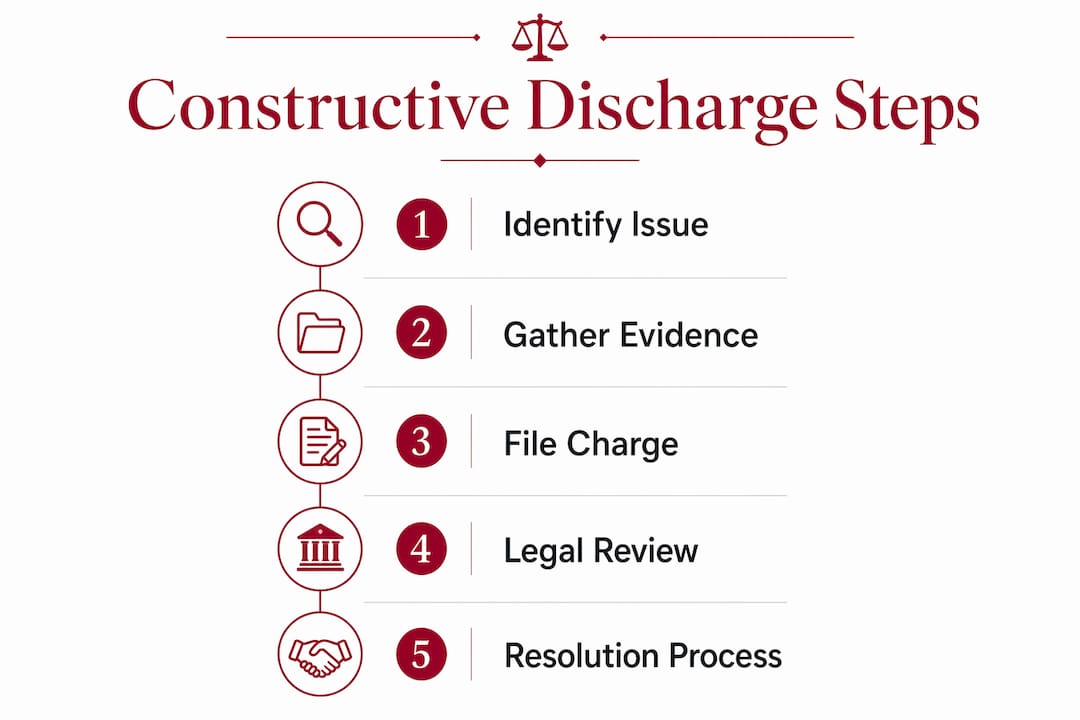
Take these steps immediately to preserve your claim:
-
Write down every incident with dates, times, locations, and witnesses while memory is fresh
-
File a written complaint with HR or a supervisor (email is better than verbal)
-
Preserve all relevant emails, texts, performance reviews, and disciplinary documents
-
Note any medical treatment or therapy connected to workplace stress
-
Do not wipe, return, or factory-reset any work device until you speak with an attorney
The filing clock starts the day you resign, not the day of the last discriminatory act. Under Green v. Brennan, the EEOC and California Civil Rights Department (CRD) deadlines are triggered by your resignation date. Contact an attorney immediately if you have already resigned, if your employer is retaliating against you for complaining, or if the conduct involves race, religion, sex, disability, or another protected characteristic.
Pro Tip: Do not delay filing an administrative charge while waiting to “see how things go.” Missing the EEOC or CRD window can permanently bar your claim, regardless of how strong your facts are.
Table of Contents
- What constructive discharge means under California law
- How to prove a constructive discharge claim: elements and court-ready evidence
- Actionable examples that typically support a claim, and scenarios that usually don’t
- What remedies and damages you can seek if your constructive discharge claim succeeds
- Filing pathways, statute of limitations, and immediate procedural steps
- How an employment attorney handles a constructive discharge case
- Key Takeaways
- Why documentation is the case, not just evidence
- Javitchlawoffice can evaluate your constructive discharge case
- Authoritative sources and further reading
What constructive discharge means under California law
Constructive discharge is the legal doctrine that treats a forced resignation as a termination. Under California law, a resignation qualifies when an employer intentionally created or knowingly permitted working conditions so intolerable that a reasonable employee would have had no alternative but to quit. The standard comes directly from CACI No. 2510, California’s civil jury instruction for constructive discharge.
The test is objective, not subjective. Courts do not ask whether you personally felt you had no choice. They ask whether a reasonable person in your exact circumstances, facing the same conduct, would have reached the same conclusion. This distinction matters because it filters out ordinary workplace frustration while protecting employees from genuinely unlawful conditions.
The conditions must be tied to an unlawful motive or a violation of law. Under California’s Fair Employment and Housing Act (FEHA) and federal analogs like Title VII, actionable bases include workplace discrimination based on race, religion, sex, national origin, disability, or age; sexual or racial harassment; retaliation for whistleblowing or requesting FMLA/ADA accommodations; and wage-and-hour violations such as unpaid overtime or denial of protected leave. As Super Lawyers notes, intolerable conditions must be linked to a violation of public policy or statutory rights, not mere personality conflicts.
Ordinary job dissatisfaction does not qualify. A difficult manager, a missed promotion, or a lateral transfer you dislike are not constructive discharge. The doctrine targets employer conduct that crosses a legal line.
How to prove a constructive discharge claim: elements and court-ready evidence
Proving constructive discharge is genuinely difficult. The employee carries the burden of showing, by a preponderance of the evidence, that the employer’s conduct left no reasonable alternative but to resign. Courts focus on three core elements:
- Employer intent or knowledge. The employer either deliberately created the intolerable conditions or knowingly tolerated them after receiving notice.
- Objective intolerability. A reasonable person in the employee’s position would have felt compelled to resign.
- Causal link. The resignation was a direct result of those conditions, not an unrelated personal decision.
Evidence that typically supports a claim:
- Internal HR complaints (written, dated, with employer responses)
- Emails, texts, or Slack messages documenting the conduct or employer awareness
- Performance reviews or disciplinary documents issued after a protected complaint
- Pay stubs showing a sudden pay cut or demotion tied to protected activity
- Witness names and written statements from colleagues who observed the conduct
- Medical records or therapy notes linking physical or psychological harm to the workplace
- A contemporaneous journal with dated entries describing each incident
The timeline structure matters as much as the individual documents. Arrange incidents in chronological order: date, actor, what happened, which document captures it, and what the employer did (or failed to do) in response. This sequence shows the pattern courts look for and demonstrates that the employer had notice and an opportunity to fix the problem.
On the question of employer notice: a verbal complaint to a supervisor counts, but written complaints are far stronger. Courts look for evidence that the employer knew about the conditions and chose not to act. EEOC guidance on retaliation confirms that timing, comparative evidence, and employer statements can all support an inference of unlawful motive, but an employer will counter with legitimate business reasons, so you need proof of pretext.

Pro Tip: Screenshot and email yourself copies of key documents before you resign. Once you leave, access to company systems typically disappears within hours. For electronic records on a work device, do not delete anything — forensic preservation of metadata can be critical if the case goes to discovery.
Actionable examples that typically support a claim, and scenarios that usually don’t
Understanding where the line falls is the fastest way to assess your own situation.
Scenarios that often support a constructive discharge claim:
A Black employee reports repeated racial slurs from a supervisor to HR. HR acknowledges the complaints but takes no corrective action over three months. The supervisor escalates to exclusion from meetings and false performance write-ups. The employee resigns. This pattern, documented complaints plus employer inaction plus escalating retaliation, is exactly what courts look for.
A female employee is demoted and her pay is cut by 20% within two weeks of filing a sexual harassment complaint. Her new role strips her of all meaningful responsibilities. She resigns after the employer denies her request for a transfer. The close timing between the protected complaint and the adverse employment actions is powerful circumstantial evidence of retaliation.
An employee is told by a manager to falsify safety records or face termination. Facing an ultimatum to break the law, the employee resigns. Under CACI No. 2510, a single severe incident, including a threat to commit a crime, can satisfy the intolerability standard without requiring a continuous pattern.
Scenarios that usually don’t:
A manager is consistently rude and dismissive, but the conduct has no connection to a protected characteristic and no formal complaints have been filed. Courts generally will not find constructive discharge from generalized workplace unpleasantness.
An employee receives a performance improvement plan (PIP) with legitimate documented reasons after repeated attendance issues. The employee resigns rather than participate. Lawful performance management, even when stressful, does not meet the objective intolerability standard.
The follow-up behavior often determines the outcome. An employee who documents incidents, files a written complaint, gives the employer a reasonable opportunity to correct the problem, and then resigns after the employer fails to act is in a far stronger legal position than one who quits immediately without notice. As LegalClarity explains, courts expect employees to act reasonably before quitting; immediate resignation without notice weakens most claims unless the situation involves immediate physical danger or a criminal ultimatum.
What remedies and damages you can seek if your constructive discharge claim succeeds
A successful constructive discharge claim entitles you to the same remedies as a wrongful termination. In California, those typically include:
- Back pay: Lost wages from the date of resignation to the date of judgment, minus any earnings from mitigation
- Front pay: Projected future lost earnings when reinstatement is not practical
- Reinstatement: Rare in practice, but available; most employees and courts prefer front pay
- Emotional distress damages: Compensatory damages for psychological harm caused by the unlawful conduct
- Punitive damages: Available in cases of malice, oppression, or fraud; fact-specific and not guaranteed
- Attorneys’ fees and costs: Available under FEHA and certain federal statutes when the employee prevails
You are also likely eligible for unemployment benefits in California when your resignation was involuntary due to intolerable conditions. The Employment Development Department (EDD) recognizes that a forced resignation can qualify as a “good cause” separation.
For federal claims under Title VII and the ADA, the Civil Rights Act of 1991 caps combined compensatory and punitive damages by employer size:
| Employer size (employees) | Federal cap (compensatory + punitive) |
|---|---|
| 15–100 | $50,000 |
| 101–200 | $100,000 |
| 201–500 | $200,000 |
| 501 or more | $300,000 |
These federal caps do not apply to back pay or front pay, and they do not apply to claims brought under 42 U.S.C. § 1981 (race discrimination) or California’s FEHA, which can yield significantly higher recoveries. The severity of the employer’s misconduct, the length of unemployment, and how aggressively you mitigated your losses all influence the final damages number.
Filing pathways, statute of limitations, and immediate procedural steps
California employees pursuing a constructive discharge claim generally have two filing pathways: a charge with the EEOC for federal claims, and a complaint with the California Civil Rights Department (CRD, formerly DFEH) for state FEHA claims. Filing with one agency typically cross-files with the other, but confirm this with your attorney.
The critical timing rule: under Green v. Brennan, the filing period begins on your resignation date, not the date of the last discriminatory act. This means the clock is already running if you have already resigned.
Key deadlines to check immediately:
- EEOC charge: Generally 300 days from the resignation date in California (a “deferral state”)
- CRD complaint: Three years from the date of the violation under California’s amended FEHA statute
- Civil lawsuit: After receiving a “right to sue” notice from the EEOC or CRD, you typically have 90 days (federal) or one year (state) to file in court
- Preserve your civil cause of action: Do not let the administrative deadline pass while waiting for an employer response or settlement discussion
Procedural steps in order:
- Preserve all evidence (devices, emails, documents, witness contact information)
- Consult an employment attorney before filing if time permits
- File an administrative charge with the EEOC and/or CRD
- Respond to any agency requests for information promptly
- Request a “right to sue” notice when the administrative process concludes or when the waiting period expires
- File your civil complaint within the applicable deadline after receiving that notice
Pro Tip: If your deadline is approaching and you have not yet retained counsel, file the administrative charge yourself first and find an attorney second. Missing the EEOC or CRD window is fatal to most claims. The agency charge form is available online and does not require a lawyer to complete.
How an employment attorney handles a constructive discharge case
The first thing a skilled employment attorney does is triage your evidence. At intake, they will review your timeline, identify the strongest documents, and assess whether the employer’s conduct clears the objective intolerability bar. They will also check for any arbitration agreements or class waivers in your employment contract that could affect where and how your claim proceeds.
Once retained, the attorney typically issues a litigation hold or preservation letter to the employer, demanding that relevant documents and communications be preserved. This step matters because employers who destroy evidence after receiving notice face sanctions. Targeted discovery follows: depositions of supervisors and HR personnel, subpoenas for internal communications, and requests for comparator data showing how similarly situated employees were treated.
Settlement demand strategy comes next. Most constructive discharge cases resolve before trial, often after the employer sees the strength of the documentary record. If the case does not settle, the attorney prepares for trial by organizing the evidence into a narrative the jury can follow, and by retaining expert witnesses where damages calculations require them.

Javitchlawoffice brings California civil-rights litigation experience to exactly this kind of case. The firm handles discrimination and retaliation claims under FEHA and federal law, pursues both state and federal remedies, and has the capacity to take cases through trial when settlement is not appropriate. For employees whose constructive discharge involved protected speech or whistleblowing, the firm’s First Amendment retaliation practice is directly relevant.
For a free confidential case evaluation, have your timeline, key documents, and a list of witnesses ready. The consult will cover the strength of your evidence, the applicable deadlines, and the realistic range of remedies available in your specific situation.
Key Takeaways
A constructive discharge claim in California requires proving objective intolerability tied to unlawful employer conduct, and the filing clock starts the day you resign.
| Point | Details |
|---|---|
| Objective test governs | Courts ask whether a reasonable person would have quit, not whether you personally felt forced out. |
| Unlawful motive is required | Conditions must be tied to discrimination, harassment, retaliation, or another statutory violation, not ordinary job dissatisfaction. |
| Federal damage caps apply | Civil Rights Act of 1991 caps combined compensatory and punitive damages from $50,000 to $300,000 depending on employer size; FEHA claims are not capped the same way. |
| Resignation triggers the clock | Under Green v. Brennan, EEOC and CRD filing deadlines run from your resignation date, making immediate action critical. |
| Javitchlawoffice | The firm handles discrimination and retaliation claims under FEHA and federal law and offers a free confidential case evaluation. |
Why documentation is the case, not just evidence
Most employees who contact an attorney after a forced resignation have a solid sense of what happened to them. What they often lack is the paper trail that turns a credible story into a winnable case. Courts do not decide constructive discharge claims on testimony alone. They look for the email where HR acknowledged the complaint and promised to investigate, the performance review that suddenly went negative two weeks after a protected complaint, the text message where a supervisor made a discriminatory comment in writing.
The gap between “I know what they did” and “I can prove what they did” is where most claims are won or lost. Employers know this. When litigation begins, their first move is usually to produce a clean-looking HR file and argue that the employee never formally complained, or that any adverse treatment was performance-based. If you have contemporaneous written complaints and the employer’s non-responses, that argument collapses. If you don’t, it tends to stick.
The other thing people underestimate is how quickly evidence disappears. Email accounts get deactivated. Slack histories get purged. Witnesses move on and memories fade. The employees who preserve evidence in real time, before they resign, are in a categorically different position than those who try to reconstruct a record after the fact. If you are still employed and conditions are deteriorating, start documenting now, even if you are not sure you will file a claim. You can always choose not to use the record. You cannot recreate it later.
Javitchlawoffice can evaluate your constructive discharge case
If you were forced out of a job because of discrimination, harassment, or retaliation, the legal path forward starts with a clear-eyed assessment of your facts and your deadlines. Javitchlawoffice is a California civil-rights firm that handles employment discrimination and retaliation cases under FEHA and federal law, including constructive discharge claims tied to race, religion, sex, disability, national origin, and protected speech.

The firm offers a free, confidential case evaluation. You do not need a polished case to call. Bring your timeline, whatever documents you have preserved, and the names of any witnesses. The evaluation will cover whether your facts support a viable claim, which deadlines apply to your situation, and what remedies are realistically available. Cases are handled on a contingency basis where applicable, meaning no upfront legal fees for qualifying matters.
Contact Javitchlawoffice through the firm’s discrimination practice page or reach out directly for a confidential intake. All communications are protected by attorney-client privilege from the first conversation.
This article provides general legal information, not legal advice. Filing deadlines, available remedies, and procedural requirements vary by case. Confirm the rules that apply to your specific situation with a qualified California employment attorney.
Authoritative sources and further reading
- EEOC Enforcement Guidance on Retaliation and Related Issues — Primary federal guidance on retaliation, materially adverse actions, and evidence of employer motive
- CACI No. 2510 — Constructive Discharge (Justia) — California’s official civil jury instruction; the controlling legal standard for California constructive discharge cases
- LegalClarity: What Is a Constructive Discharge Claim? — Accessible lay summary covering the resignation-trigger rule, filing deadlines, and remedies
- Super Lawyers: Forced to Quit? — Practical overview of actionable employer conduct and evidence requirements
- Investopedia: Constructive Discharge Claims — Plain-language explanation of the burden of proof and employer defenses
- California Civil Rights Department (CRD) — State agency responsible for FEHA enforcement; file your state complaint here
- EEOC Employee Rights Overview — Federal baseline rights against discrimination, harassment, and retaliation
- Negligent supervision and employer knowledge — Background on how employer inaction and failure to supervise can support claims
- Javitchlawoffice Discrimination Practice — Firm practice page for workplace discrimination and retaliation matters
- Fighting Discrimination in the Workplace — Javitchlawoffice Blog — Firm resource on anti-discrimination statutes and evidence collection strategies
Recommended
- Fighting Antisemitic and Racial Discrimination in the Workplace | Javitch Law Office
- Antisemitic & Racial Discrimination Attorneys | Javitch Law Office
- First Amendment Violations: When Free Speech Leads to Retaliation | Javitch Law Office
- California Public Records Act Lawyer: Enforcing Your Right to Government Transparency | Javitch Law Office