
A class action settlement notice is an official, court-approved document sent to potential class members after a court grants preliminary approval of a settlement, formally informing them of their rights and legal options. If you received one in the mail or by email, it is not junk mail. It is a legal communication that requires your attention and, in most cases, a response before a firm deadline.
California residents receive these notices regularly, from data breach settlements to consumer fraud cases involving subscription billing and product defects. The notice tells you what happened, whether you qualify for compensation, and exactly what you must do to protect your rights. Missing the deadlines listed inside can permanently forfeit your ability to collect money or pursue your own lawsuit.
What does a class action settlement notice contain?
A court-approved settlement notice is a structured document with several distinct sections, each serving a specific legal purpose. Understanding each section helps you act correctly and on time.
The class definition is the most critical section. It describes exactly who qualifies as a class member, including the time period during which you must have been affected, the geographic area covered, and the type of harm the settlement addresses. Read this section first.

Settlement terms explain what the defendant has agreed to pay or provide. This may include a cash fund, product vouchers, account credits, or injunctive relief such as a change in business practices. One 2026 settlement, for example, capped individual claims at $5,000 and required claim forms by june 23, 2026. That cap matters because it sets your maximum recovery before attorneys’ fees and administration costs are deducted.
Key deadlines appear prominently in every notice and typically include:
- The claim filing deadline: the last date to submit your settlement claim form
- The opt-out deadline: the last date to exclude yourself from the settlement
- The objection deadline: the last date to formally challenge the settlement terms
- The final approval hearing date: when the court will decide whether to finalize the deal
Contact information for the claims administrator and the court handling the case is always included. The claims administrator is the third-party company managing the settlement process on behalf of both parties.
Settlement notices come in two forms: a short-form summary and a long-form detailed version. The short form is designed to catch your attention. The long form contains the full exclusion criteria, legal release language, and complete settlement terms. If you received only the short form, find the long form on the official settlement website before making any decisions.
Pro Tip: Save the envelope or email header showing when you received the notice. This timestamp can matter if a deadline dispute arises later.
How do you know if you are eligible to file a claim?
Class action eligibility is determined strictly by the court-defined class description, not by whether you feel harmed or whether you received a notice. Most class members are automatically included in the settlement class, but automatic inclusion does not mean automatic payment. You still need to file a claim form to receive compensation in most cases.
The class definition typically uses three criteria to establish eligibility:
- Class period: You must have purchased a product, used a service, or experienced the harm within a specific date range, such as between january 1, 2020, and december 31, 2024.
- Geographic scope: Some settlements cover only residents of certain states. California residents are frequently named in consumer protection settlements due to the state’s strong consumer laws.
- Type of harm: You must have experienced the specific harm described, such as receiving unauthorized text messages, being charged undisclosed fees, or having personal data exposed in a breach.
Not receiving a notice does not mean you are excluded. Notices sometimes fail to reach eligible individuals due to outdated addresses or email filtering. Check the official settlement website directly by searching the case name or defendant’s name alongside the term “settlement” in a search engine. Court records are also publicly accessible and can confirm whether a settlement exists.
If you are unsure whether you qualify, contact the claims administrator directly. Their phone number and email appear in the notice. Describe your situation and ask whether your circumstances fit the class definition. This call costs you nothing and can save you from missing a valid claim.
Pro Tip: Screenshot or print the official settlement website’s eligibility page. Settlement websites sometimes go offline after the claim deadline passes, and you may need that record later.
What are your legal options after receiving the notice?
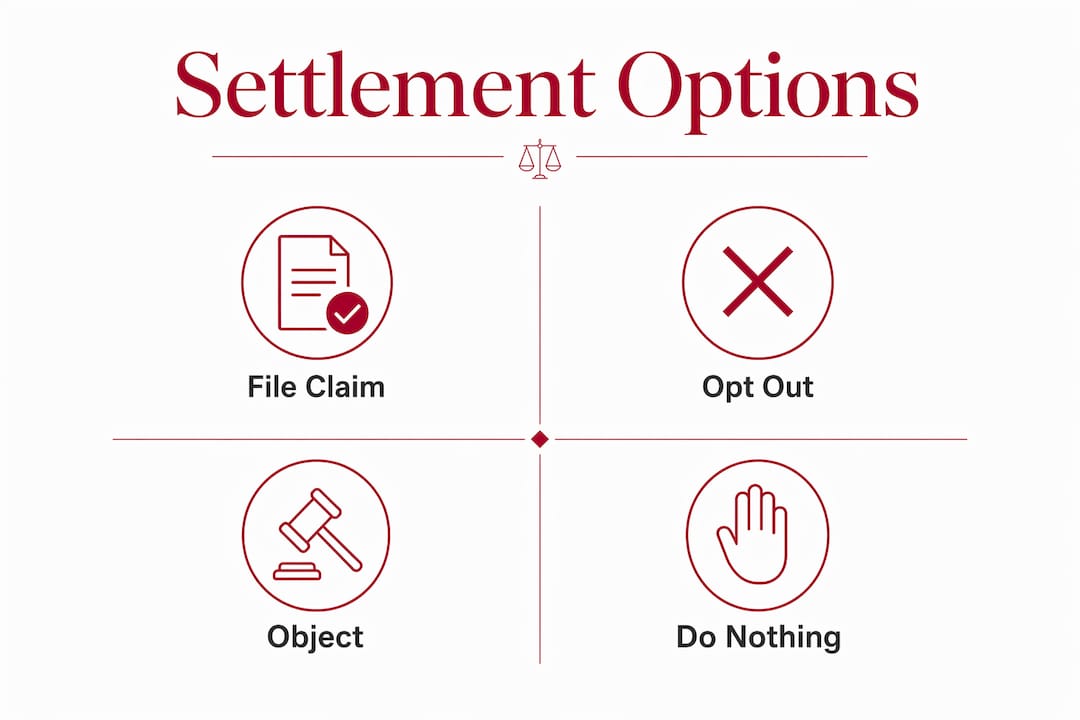
Every class action settlement notice presents you with three distinct choices, and each carries permanent legal consequences. Understanding what each option means before the deadline is the most important step you can take.
Option 1: File a claim
Filing a claim is the most common choice. You submit a settlement claim form, either online or by mail, providing the information required to verify your eligibility. This typically includes your name, contact details, proof of purchase or account information, and sometimes a description of the harm you experienced.
Accuracy matters. Errors or missing information can delay your payment or result in your claim being rejected. Submit the form before the deadline, keep a copy, and note your confirmation number if the process is online.
Option 2: Opt out of the settlement
Opting out means you exclude yourself from the settlement entirely. You give up your right to receive any payment from this case, but you preserve your right to file your own individual lawsuit against the defendant. Missing the opt-out deadline permanently binds you to the settlement’s legal release, which means you can never sue the defendant over the same claims again.
Opting out makes sense when your individual damages are significantly larger than the settlement payout, or when you have strong evidence supporting a standalone case. Consult an attorney before choosing this path. Javitchlawoffice handles consumer class action cases and can assess whether your individual claim warrants separate action.
Option 3: Object to the settlement
Objecting means you stay in the class but formally tell the court that you believe the settlement terms are unfair, inadequate, or unreasonable. You file a written objection with the court by the stated deadline. The judge reviews all objections before granting final approval.
Objections are powerful tools when the settlement compensation is too low, the attorneys’ fees are disproportionate, or the release of claims is overly broad. An objection does not guarantee a better outcome, but it puts your concerns on the court record.
The cost of doing nothing
Ignoring a settlement notice is rarely the right move. In most cases, doing nothing means you stay in the class, receive no payment because you never filed a claim, and still lose your right to sue the defendant independently. You get the worst of all outcomes.
Pro Tip: Set three calendar reminders: one for the claim deadline, one for the opt-out deadline, and one for the objection deadline. Courts do not grant extensions for missed personal deadlines.
What happens after you file a claim?
Filing a claim starts a process that unfolds over several months, sometimes longer. The court must grant final approval of the settlement before any money changes hands.
After the objection and opt-out deadlines pass, the court holds a final approval hearing. The judge reviews the settlement terms, any objections filed, and the attorneys’ fee request. If the judge approves the settlement, a waiting period follows during which any party can appeal the decision. Appeals can extend the timeline by a year or more.
Once the settlement becomes final and non-appealable, the claims administrator reviews all submitted claim forms. They verify eligibility, calculate individual payment amounts based on the settlement formula, and flag any incomplete or suspicious submissions for follow-up.
Payments after claim approval can take several months to over a year to arrive. The exact timeline depends on the size of the class, the number of claims filed, and whether any appeals were filed. Payments arrive in several forms:
- Paper checks mailed to the address you provided
- Direct deposit or PayPal transfers if you selected that option
- Account credits applied directly to your account with the defendant
- Vouchers or discount codes for future purchases
Track your claim status through the official settlement website. Most administrators provide a claim status lookup tool using your confirmation number. If your check expires before you cash it, contact the administrator immediately. Many settlements allow reissuance within a limited window.
The settlement’s legal release takes effect once you accept payment. This means you permanently give up the right to sue the defendant over the specific claims covered by the settlement. Read the release language in the long-form notice before you cash any check.
Key Takeaways
A class action settlement notice is a legally binding communication that requires a specific response before firm court-imposed deadlines, and missing those deadlines permanently affects your legal rights.
| Point | Details |
|---|---|
| Act before every deadline | Missing claim, opt-out, or objection deadlines permanently forfeits your rights with no exceptions. |
| Verify your eligibility directly | Check the official settlement website or call the claims administrator if you are unsure whether you qualify. |
| Three options exist | You can file a claim, opt out to sue independently, or object to the settlement terms in court. |
| Payment takes time | Distributions typically take several months to over a year after final court approval. |
| Doing nothing costs you | Ignoring the notice usually means no payment and no right to sue the defendant independently. |
What I have learned from watching people mishandle these notices
Most people who miss out on settlement money do not miss out because they were ineligible. They miss out because they assumed the notice was spam, set it aside, and never came back to it. I have seen this pattern repeatedly, and it is entirely avoidable.
The second most common mistake is assuming that being automatically included in the class means a check is coming. It does not. Automatic inclusion means you are bound by the settlement. Getting paid requires filing a claim form. Those are two completely different things, and the notice buries this distinction in plain sight.
The third mistake is treating the opt-out decision casually. Opting out is not a minor administrative choice. It is a permanent legal election. Once that deadline passes, failure to opt out legally waives your individual litigation rights against the defendant on those specific claims. If you have a strong individual case, that waiver can cost you far more than any class settlement would have paid.
My honest advice: treat every settlement notice the way you would treat a certified letter from the IRS. Read it the day it arrives. Identify the earliest deadline. Then decide what to do. You do not need an attorney for every claim, but for any case where your individual damages are substantial, or where the release language is unusually broad, a 30-minute consultation with a civil rights or consumer protection attorney is worth every minute.
Verify the settlement is legitimate before you submit any personal information. Practitioners advise confirming legitimacy through court records and official administrators. Search the case name in PACER, the federal court records system, or your state court’s online docket. Scammers do send fake settlement notices designed to harvest personal data, and they look convincing.
— Mark
How Javitchlawoffice can help you navigate your settlement rights
Receiving a settlement notice is straightforward when the claim is simple and the payout is modest. The situation gets more complicated when the settlement involves significant compensation, a broad legal release, or claims that may be worth more pursued individually.
Javitchlawoffice is a California-based civil rights and consumer protection firm with experience in consumer class actions involving TCPA violations, auto-renewal billing abuses, and price rule violations. If you received a notice and are unsure whether to file, opt out, or object, the attorneys at Javitchlawoffice can review your situation and give you a direct answer. California residents dealing with discrimination-related class actions can also find support through Javitchlawoffice’s civil rights practice. Reach out before your deadline passes.
FAQ
What is a class action settlement notice?
A class action settlement notice is a court-approved document sent to potential class members after preliminary settlement approval, explaining their eligibility, options, and deadlines. It is a formal legal communication, not promotional material.
Do I have to do anything after receiving a settlement notice?
You are not legally required to act, but doing nothing typically means you receive no payment and still lose your right to sue the defendant independently. Filing a claim form is the only way to receive compensation in most settlements.
How do I know if the settlement notice I received is legitimate?
Verify the settlement by searching the case name in public court records through PACER or your state court’s online docket. The official settlement website will also list the court, case number, and claims administrator contact information.
What happens if I miss the claim deadline?
Missing the claim deadline means you forfeit your right to receive any payment from the settlement. Courts do not grant individual extensions, and the claims administrator cannot accept late submissions once the deadline has passed.
Can I still sue the defendant if I file a claim?
No. Accepting a settlement payment releases your right to sue the defendant over the specific claims covered by the case. If you want to preserve your right to sue independently, you must opt out of the settlement before the opt-out deadline.