
Antisemitic harassment means targeting someone with hostility, threats, slurs, vandalism, or exclusion because they are (or are perceived to be) Jewish, and it has surged across schools, workplaces, and the internet. A majority of Jewish Americans reported experiencing some form of antisemitic harassment in the past year. The main federal remedy runs through a Title VI complaint filed with the U.S. Department of Education’s Office for Civil Rights, and the first move for any victim is simple: write down what happened, save the evidence, and talk to a lawyer before the trail goes cold.
TL;DR:
- Over half of Jewish Americans experienced antisemitic harassment in the past year, with nearly 20% facing direct physical harm or threats.
- Assaults with deadly weapons have increased to historical highs, indicating a shift from vandalism to violence in recent antisemitic incidents.
- Most harassment occurs online, in schools, and at Jewish community sites, with institutions often failing to formally document or respond adequately.
- The legal framework under Title VI requires institutions receiving federal funding to address discrimination based on shared ancestry, with investigations often triggered by documented patterns.
- Early documentation, including incident logs and legal counsel, is crucial for building effective cases and achieving lasting institutional change.
Table of Contents
- Recent Incidents and Trends in Antisemitic Harassment Across the U.S.
- Defining Antisemitic Harassment: Legal Standards and Common Forms
- Title VI, OCR, and the Federal Enforcement Path
- Holding Schools, Colleges, and Employers Accountable
- Documenting and Reporting Antisemitic Harassment: A Practical Roadmap
- Federal Policy Actions Shaping Enforcement Since 2026
- Staying Safe: Immediate Steps and Community Resources
- The Psychological Toll of Antisemitic Harassment
- How Antisemitic Harassment Intersects With Other Forms of Discrimination
- A Brief History of Antisemitic Harassment in America
- Building Prevention Into Schools and Workplaces
- Why Early Legal Strategy Changes the Outcome
- Get Legal Support From Javitch Law Office
- Primary Sources for Further Reading
- Sources
Recent Incidents and Trends in Antisemitic Harassment Across the U.S.
The numbers from the last survey cycle are stark. Over a 12-month period, 55% of Jewish Americans reported at least one form of antisemitism, and 18% said they experienced direct harm, meaning a physical attack, a threat, or verbal harassment aimed straight at them. This is not a fringe problem measured in dozens of anecdotes. It is a majority of experience among a religious minority in the United States.
By the numbers: More than half of Jewish Americans faced antisemitism in the past year, and nearly one in five suffered direct harm, according to the joint Jewish Federations and ADL survey.
Violence is climbing too. The Anti-Defamation League’s own tracking shows a historic high in antisemitic assaults and attacks involving deadly weapons in the most recent reporting period, a shift from the vandalism and verbal harassment that once dominated incident logs. Assaults with weapons used to be the rarest category ADL tracked. That is no longer true.
Where does this harassment actually happen? The pattern splits across a handful of recurring settings:
- Online spaces — coordinated harassment campaigns, doxxing, and targeted abuse on social platforms, often spilling into real-world threats.
- K-12 schools — bullying that mimics ordinary schoolyard conflict on the surface but carries slurs, swastika graffiti, or exclusion tied directly to a student’s Jewish identity.
- College campuses — protests, encampments, and classroom incidents that cross from political expression into targeted harassment of Jewish students specifically.
- Public accommodations — synagogues, kosher restaurants, and Jewish community centers facing vandalism, threats, or physical confrontation.
- Workplaces — exclusion, slurs, or retaliation against employees who are identified as Jewish or who raise concerns about antisemitic conduct.
The California cases are instructive here. OCR opened investigations into San Jose State University and San Francisco State University to determine whether the schools violated Title VI by failing to respond to antisemitic harassment on campus, and those inquiries became a template other institutions now watch closely. Reporting gaps remain the elephant in the room. Survey data captures far more incidents than any institution’s internal complaint log, which tells you the formal reporting system is catching only a fraction of what victims actually experience.
Defining Antisemitic Harassment: Legal Standards and Common Forms
The IHRA working definition, adopted for reference by the U.S. State Department, describes antisemitism as a certain perception of Jews expressed as hatred, directed at Jewish or non-Jewish individuals, their property, community institutions, or religious facilities. It comes with a list of contemporary examples that institutions and investigators use to evaluate specific incidents, rather than leaving “antisemitism” as an abstract label anyone can argue about.
Concrete forms of antisemitic harassment tend to fall into recognizable categories:
- Direct slurs and threats — verbal or written attacks invoking Jewish identity, including threats of violence against individuals or institutions.
- Vandalism — swastikas, defaced mezuzahs, or damage to synagogues and Jewish-owned businesses.
- Exclusion — deliberately leaving Jewish students, employees, or community members out of groups, events, or opportunities because of their identity.
- Stereotyping — invoking conspiracy tropes about Jewish power, wealth, or loyalty.
- Coordinated online harassment — organized campaigns of abuse, doxxing, or impersonation targeting Jewish individuals or organizations.
Context matters enormously here, and this is where a lot of institutional confusion sets in. The IHRA definition itself is explicit that criticism of Israel similar to that leveled against any other country is not automatically antisemitic. The line gets crossed when criticism shifts into targeting Jewish students or employees as stand-ins for a foreign government, applying double standards specifically to Jewish people or Israel, or using classic antisemitic tropes dressed up as political commentary.
That distinction is exactly why some administrators mislabel identity-based harassment as ordinary “political disagreement” and decline to investigate. Experts who reviewed the Reed College settlement point out that institutions often default to treating antisemitic incidents as generic misconduct rather than identity-based discrimination, and that framing choice determines whether Title VI obligations even get triggered.
Title VI, OCR, and the Federal Enforcement Path
Title VI of the Civil Rights Act of 1964 bars discrimination on the basis of race, color, or national origin in any program receiving federal funding, and courts and OCR both treat antisemitic harassment as covered conduct when it targets actual or perceived shared ancestry. That coverage extends to nearly every public school district, state university, and community college in the country, since almost all of them accept federal funds in some form.
Here is how the enforcement path typically unfolds:
- A complaint gets filed, either directly with OCR or internally with the institution’s Title VI coordinator, describing the harassment and the institution’s response (or lack of one).
- OCR opens an investigation if the complaint states a plausible Title VI violation, as happened with San Jose State and San Francisco State and with a Florida school district facing similar allegations.
- Investigators gather evidence, including incident logs, institutional emails, witness statements, and prior complaints showing whether the response was adequate.
- OCR issues findings, either clearing the institution or determining a violation occurred.
- A resolution agreement follows a violation finding, typically requiring training, policy changes, monitoring periods, and sometimes a dedicated Title VI coordinator.
The Department of Justice steps in on a different track, generally reserved for patterns severe enough to warrant civil litigation or criminal referral, particularly where violence or coordinated threats are involved. State civil rights agencies and state attorneys general offer parallel avenues, especially for workplace harassment claims that fall under state fair employment statutes rather than Title VI.
Timelines run long. OCR investigations frequently take many months to over a year depending on complexity and the institution’s cooperation, and evidence thresholds matter enormously: a single slur is rarely enough to prove “deliberate indifference,” the legal standard OCR and courts apply, but a documented pattern the institution knew about and ignored usually is. Victims dealing with workplace situations should review their options for fighting discrimination in the workplace early, since employment claims often run on shorter statutory deadlines than campus Title VI complaints.
Holding Schools, Colleges, and Employers Accountable
Institutions fail in predictable ways. The most common pattern investigators flag is “deliberate indifference,” meaning the school or employer knew about the harassment and responded with inconsistent, delayed, or purely cosmetic action. A single diversity training session after years of ignored complaints does not satisfy Title VI. Neither does disciplining one student while leaving the underlying policy gaps untouched.
When OCR or a court does find a violation, the remedies follow a fairly consistent playbook:
- Adoption of a working definition of antisemitism, often the IHRA framework, to give staff a concrete standard for evaluating complaints.
- Mandatory training for administrators, faculty, or managers on recognizing and responding to identity-based harassment.
- A designated Title VI coordinator responsible for intake, tracking, and follow-up on discrimination complaints.
- Multi-year monitoring, sometimes involving independent evaluators who report back to OCR or a court.
- Public acknowledgment of the violation, which settlements increasingly require rather than allowing quiet, unannounced compliance.
Reed College’s settlement illustrates the template well: the college agreed to mandatory antisemitism training, formal adoption of the IHRA working definition as an assessment tool, a Title VI coordinator, and independent monitoring stretched across several years. Analysis of that settlement suggests agreements requiring public denunciation, real training, and outside monitoring produce more durable change than a private apology and a policy memo nobody reads.
Pro Tip: If your school or employer’s response to a reported incident consists only of a verbal warning to the offender and no written record, ask for the incident to be documented in writing. An undocumented response looks identical to no response at all if the case ever reaches OCR.
Parents dealing with a school that refuses to act have real options beyond waiting for a federal investigation to run its course, including pursuing legal remedies when schools fail to protect students.
Documenting and Reporting Antisemitic Harassment: A Practical Roadmap
Evidence wins these cases, and evidence decays fast if nobody captures it in the moment. Practitioners consistently advise victims to keep a running, dated log rather than relying on memory weeks later, and to put complaints in writing rather than trusting an oral conversation with a supervisor or dean to count as a formal report.
Follow this sequence when an incident occurs:
- Write it down immediately — date, time, exact words used, location, and who was present. Memory fades within days; a contemporaneous log holds up in an investigation in ways a reconstructed memory does not.
- Preserve digital evidence — screenshot messages, posts, or emails before they can be deleted, and save metadata where possible rather than just a cropped image.
- Identify witnesses — get names or descriptions of anyone who saw or heard the incident while their memory is still fresh.
- File a written complaint with the institution — send it to HR, a Title VI coordinator, or a school administrator by email so there is a timestamp and a paper trail.
- File an OCR complaint if the institution fails to respond — OCR complaints require the institution’s name, a description of the harassment, dates, and an explanation of how the response fell short; attaching your incident log and copies of internal complaints strengthens the filing considerably.
- Consult an attorney before deciding on litigation — especially once multiple incidents establish what courts call a “pattern and practice,” which carries far more weight than one isolated slur.
That pattern-and-practice distinction is worth sitting with. A single ugly comment is hard to litigate. A documented sequence of incidents the institution knew about and failed to address is a different case entirely, and it is exactly the kind of evidence early legal counsel helps preserve and organize before it gets scattered or lost. Firms structure intake around exactly this: pulling together the incident log, the internal complaints, the institution’s responses (or silence), and any witness statements into a coherent timeline before a single filing goes out.
Pro Tip: Do not wait for the “big” incident to start documenting. Smaller incidents that seem too minor to report on their own often become the pattern-and-practice evidence that makes a later, more serious incident actionable.
Employees facing workplace antisemitism should review their specific rights and legal options as Jewish employees before filing anything, since workplace claims run through different statutes and shorter deadlines than school-based Title VI complaints.
Federal Policy Actions Shaping Enforcement Since 2026
Executive-level policy has moved fast on this issue. In January 2025, the White House issued an Executive Order titled “Additional Measures to Combat Anti-Semitism,” directing federal agencies to use every available legal tool against antisemitism, with particular emphasis on enforcement in institutions that receive federal funding. That order raised the stakes for schools and universities that had previously treated antisemitism complaints as a lower priority than other civil rights matters.
Advocacy organizations do much of the work that turns policy into pressure on the ground:
- ADL publishes detailed incident audits that track assaults, harassment, and vandalism by category and region, giving journalists, lawmakers, and OCR investigators a documented baseline.
- Jewish Federations conduct survey research capturing lived experience that never makes it into a formal police report or campus complaint.
- Media coverage of high-profile campus and school incidents frequently precedes, and sometimes triggers, a formal OCR inquiry.
- Public pressure campaigns from parents, alumni, and community groups have pushed institutions toward settlements they initially resisted.
The interplay matters more than any single actor. An ADL audit documents a spike, journalists cover it, parents and students organize, and OCR opens an inquiry that might never have started from a single complaint alone. That is roughly the sequence that preceded the Bay County, Florida investigation and several of the California campus cases.
Staying Safe: Immediate Steps and Community Resources
Personal safety comes first, before any legal process. If you feel physically threatened, contact local law enforcement immediately and separately from any institutional or civil rights complaint you plan to file. The two tracks run in parallel, not in sequence.
A few practical safety habits make a real difference:
- Vary routines if you feel targeted or watched, and tell a trusted friend or family member your schedule.
- Coordinate with synagogue or community security teams, many of which now maintain trained volunteer or professional security details and direct hotlines for reporting threats.
- Use community reporting hotlines run by local Jewish federations or ADL regional offices, which track patterns across a community rather than isolated incidents.
- Seek trauma-informed mental health support through Jewish Family Services chapters or community mental health referral networks rather than waiting for symptoms to worsen.
- Push your workplace or school toward a written incident-response plan before a crisis hits, not after.
Schools that treat antisemitic bullying as ordinary misconduct rather than identity-based harassment tend to under-respond, and experts tracking school bullying patterns note that proactive educator training reduces incidents more effectively than reactive discipline after the fact.
The Psychological Toll of Antisemitic Harassment
Harassment tied to identity does not fade the way an isolated insult does. Victims frequently describe hypervigilance, a persistent sense of being watched or singled out, that outlasts the specific incident by months or years. Jewish students who experience campus harassment often report withdrawing from classes, social groups, or extracurriculars where the harassment occurred, which compounds the harm well beyond the original event.
The social ripple effects extend past the individual target. When a school or workplace fails to respond visibly, other Jewish students or employees in that environment absorb the message that reporting will not help, which suppresses future complaints and lets patterns continue unchecked. That silence is part of why the reporting gap between survey data and formal complaint numbers runs so wide.
Family and community relationships shift too. Parents of harassed students often report increased anxiety about safety that shapes everyday decisions, from which extracurriculars to sign up for to whether to wear a Star of David necklace in public. None of this shows up in an institutional incident log, but it shows up in the survey data, and it is a real cost of harassment that goes far beyond the incident itself.
How Antisemitic Harassment Intersects With Other Forms of Discrimination
Antisemitism rarely operates in isolation. Jewish people of color face harassment that combines antisemitic tropes with racial bias, and institutions sometimes struggle to categorize the complaint correctly because it does not fit neatly into a single protected category. That mismatch can delay or complicate a Title VI response if investigators default to treating it as one form of discrimination rather than recognizing the compounded harm.
Religious discrimination law itself sits at an intersection worth understanding. Title VI covers antisemitism as a form of discrimination based on shared ancestry or ethnic characteristics, while other statutes address religious discrimination more broadly, and a strong complaint often invokes both frameworks depending on the facts. Anyone navigating a case that touches faith, ethnicity, and national origin together should understand how religious discrimination law interacts with Title VI’s ancestry-based protections rather than assuming only one framework applies.
Political speech around Israel adds another layer of complexity, particularly on campuses where protest activity and antisemitic harassment can occur in the same space without being the same thing. Coverage of how Israel policy shapes U.S. political debate shows how quickly foreign policy disagreements bleed into domestic climate, sometimes providing cover for harassment that has little to do with policy and everything to do with targeting Jewish identity.
A Brief History of Antisemitic Harassment in America
Antisemitic harassment in the United States did not start with social media or campus protests. Restrictive covenants, employment quotas, and exclusion from clubs and universities defined much of the 20th century experience, and formal legal protections against this kind of discrimination did not exist until the Civil Rights Act of 1964 created Title VI’s framework.
What has changed is the terrain, not the underlying hostility. Harassment that once relied on physical vandalism or face-to-face slurs now spreads through coordinated online campaigns that can reach thousands of people in hours, and threats that once stayed local now cross state lines instantly. The venues have multiplied even as the core motivation, hostility toward Jewish identity, has stayed remarkably consistent across generations.
Legal recognition has been slower to catch up than the harassment itself. For decades, antisemitic bullying in schools got treated as ordinary misconduct rather than identity-based discrimination, which meant it rarely triggered the civil rights protections that were technically available. The recent wave of OCR investigations and settlements reflects a shift toward finally applying Title VI’s ancestry-based protections the way they were designed to work.
Building Prevention Into Schools and Workplaces
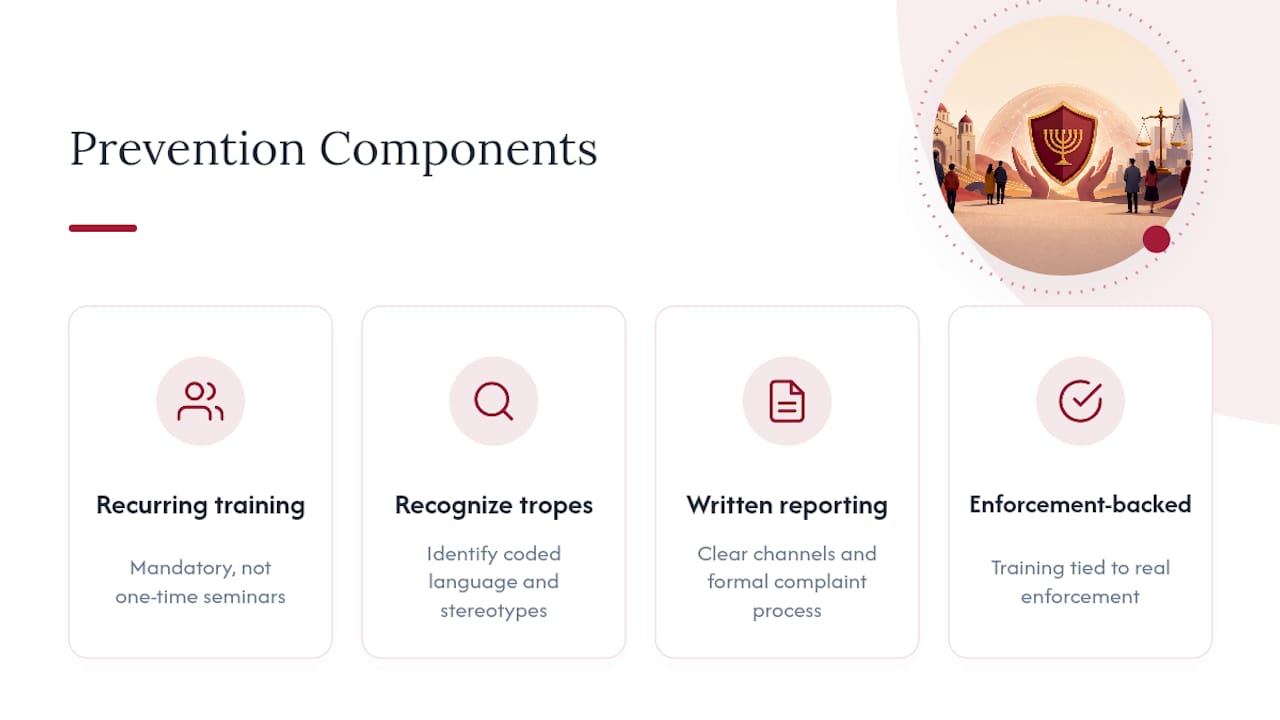
Reactive discipline after an incident matters less than prevention infrastructure built before one happens. Institutions that invest in mandatory training for staff and administrators, not just a one-time seminar, tend to catch and address harassment earlier, before it escalates into the kind of pattern that triggers a federal investigation.
Effective programs share a few common features. They train staff to recognize antisemitic tropes and coded language, not just overt slurs, since much of the harassment documented in recent surveys uses stereotypes and conspiracy language rather than blunt insults. They also establish clear, written reporting channels so students and employees know exactly where a complaint goes and what happens next, rather than guessing whether an oral mention to a teacher or manager counts as a formal report.
Curriculum choices matter here too, particularly in K-12 settings where ethnic studies and social studies content sometimes brushes against politically charged material. Understanding the legal boundaries around ethnic studies curriculum helps parents and administrators distinguish between legitimate educational content and material that crosses into fostering a hostile environment for Jewish students.
The strongest programs pair prevention with accountability, meaning training gets backed by a real enforcement mechanism rather than existing as a compliance checkbox nobody follows up on.
Why Early Legal Strategy Changes the Outcome
Most people wait too long to bring in a lawyer, treating legal counsel as a last resort after every other option has failed. That is backwards. The cases that produce real institutional change, mandatory training, a Title VI coordinator, independent monitoring, almost always started with careful documentation and legal framing from the beginning, not a lawsuit filed in desperation after months of unanswered complaints.
Javitch Law Office has built its antisemitism and racial discrimination practice around exactly that principle: get involved early enough to shape how evidence gets gathered and how a complaint gets framed, because a well-documented pattern-and-practice case settles very differently than a single unsupported allegation. The firm’s nationwide reach, paired with hands-on knowledge of how OCR and Title VI actually function, means clients get a strategy built for the specific institution and situation rather than a generic complaint template.
If you are dealing with harassment right now, do not wait for it to get worse before talking to someone who handles these cases regularly.
— Mark
Get Legal Support From Javitch Law Office
Javitch Law Office is built specifically for cases like the ones covered here, not general civil litigation stretched to fit antisemitism claims. The firm handles antisemitism and religious discrimination, student Title VI complaints, workplace harassment, and the kind of institutional accountability cases that require someone who already understands how OCR investigations and settlements actually work.
A consultation typically starts with a review of your documentation: incident logs, screenshots, written complaints you have already filed, and any response (or lack of one) from the institution involved. Many discrimination and harassment cases are handled on contingency, meaning you owe nothing upfront and fees come from a settlement or judgment rather than out of your pocket during the case. Before you reach out, gather what you have: dates, quotes, screenshots, and names of witnesses, even if the file feels incomplete.
If your situation involves a school or university, the firm’s student discrimination practice focuses specifically on Title VI complaints and campus accountability. For workplace harassment or broader discrimination claims, review the discrimination practice overview or contact the firm directly through Javitchlawoffice to start a case evaluation today.
Primary Sources for Further Reading
The documents behind this article are worth reading directly, especially if you are drafting a complaint or citing legal standards yourself.
- Portrait of Antisemitic Experiences in the U.S., 2024-2025 — Jewish Federations and ADL survey data on prevalence and harm.
- ADL press release on historic-high antisemitic assaults — incident tracking and violent-crime trends.
- IHRA working definition of antisemitism — the framework used by the State Department and many institutions.
- OCR investigation announcement, SJSU and SFSU — a working example of a Title VI inquiry.
- Reed College settlement coverage — a template for settlement remedies and monitoring terms.
- White House Executive Order, “Additional Measures to Combat Anti-Semitism” — federal policy directive shaping enforcement priorities.
This article is general information, not a substitute for advice from a qualified lawyer. Consult a qualified legal professional about your own circumstances before acting on anything here.
Sources
- Portrait of antisemitic experiences in the U.S., 2024-2025 | Jewish Federations & ADL summary
- U.S. Department of Education investigates alleged antisemitic harassment at two California universities | U.S. Department of Education
- Additional Measures to Combat Anti‑Semitism | The White House