
When you are deciding between AAA and JAMS for arbitration, the short answer is this: AAA works better for smaller, cost-sensitive disputes where predictable procedures matter, and JAMS is the stronger choice when you need a former judge, flexible case management, and you can absorb premium fees. The difference is not just administrative. It shapes how your case is run, what evidence gets heard, and whether an appeal is even realistic.
Here is a quick breakdown before diving deeper:
-
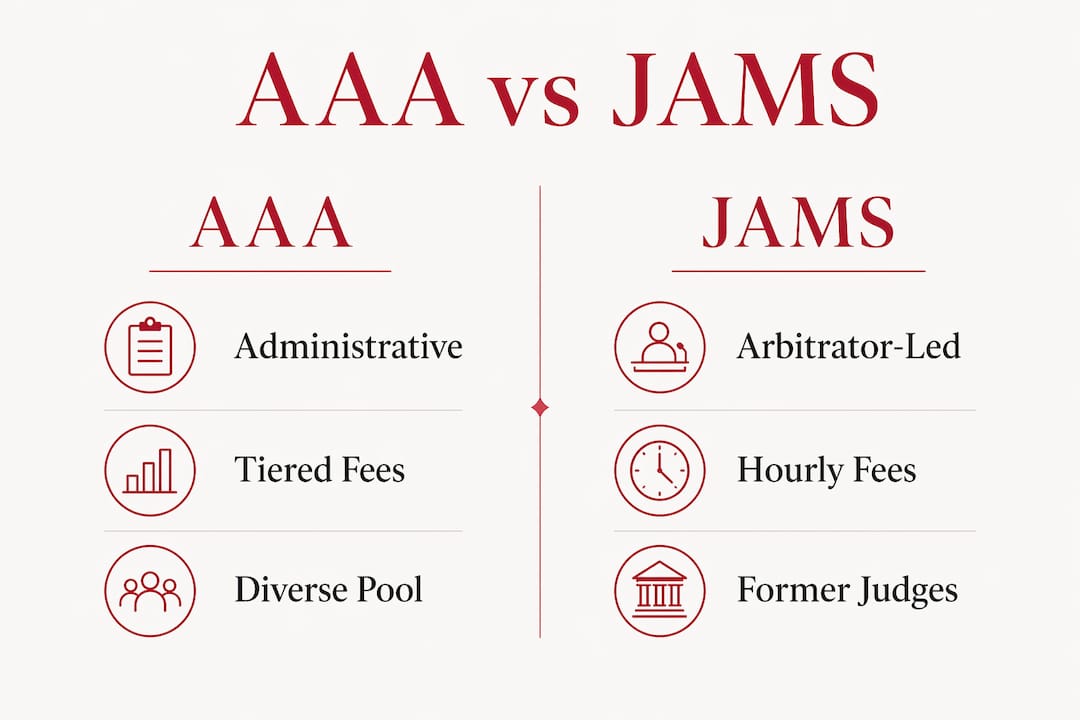
Cost: AAA uses tiered flat filing fees; JAMS charges higher hourly rates, often reflecting the premium for arbitrators with judicial backgrounds
-
Arbitrator profile: AAA draws from a broad industry panel; JAMS leans heavily on retired federal and state judges
-
Case management: AAA is administratively driven; JAMS arbitrators take a hands-on, judicial role
-
Timelines: AAA expedited procedures target roughly 90 days; JAMS typically resolves cases in 4–9 months
-
Appeals: AAA offers limited appellate rules; JAMS allows a broader appeal process if both parties agree
-
Best fit: AAA for standard commercial or consumer disputes; JAMS for complex, high-value, multi-party matters
Pro Tip: Treat your arbitration forum selection as a strategic contract drafting decision, not a boilerplate default. The forum you name in a contract clause determines the rules, the arbitrator pool, and the cost structure before any dispute even arises.
Table of Contents
- What AAA and JAMS actually are
- How AAA vs JAMS case management actually differs
- Cost considerations: where AAA and JAMS diverge sharply
- How your choice of forum affects legal outcomes
- When to choose AAA and when to choose JAMS
- How neutrality and impartiality standards compare
- Procedural rules and flexibility: a closer look
- How arbitrator selection works in each system
- Specialized arbitration expertise: where each provider leads
- Customer service and administrative support differences
- Key Takeaways
What AAA and JAMS actually are
Both organizations administer private dispute resolution, functioning as the institutional backbone behind arbitration proceedings that replace public court litigation. Understanding their origins clarifies why they attract different types of cases.
- AAA (American Arbitration Association): Founded in 1926 following the Federal Arbitration Act, AAA is the oldest and largest arbitration administrator in the United States. It sets procedural rules, appoints arbitrators, manages filings, collects fees, and oversees the entire process. Its arbitrator panel spans a wide range of industries, making it the default choice in many consumer contracts, credit card agreements, and standard commercial deals.
- JAMS (formerly Judicial Arbitration and Mediation Services): Founded in 1979, JAMS built its reputation on recruiting retired federal and state judges as arbitrators. It administers proceedings, maintains its own arbitrator roster, sets procedural rules, and handles scheduling. Contracts involving higher-dollar disputes or complex commercial matters frequently specify JAMS.
Both are widely recognized, and awards from either institution are enforceable under the Federal Arbitration Act. The choice between them is less about legitimacy and more about fit.
How AAA vs JAMS case management actually differs
The procedural gap between these two providers is where most of the practical difference lives.
AAA runs a more administrative model. Its rules are structured, its pre-hearing protocols are standardized, and mandatory mediation is built into many of its procedures. That structure benefits parties who want predictability. AAA’s expedited procedures generally conclude relatively quickly compared to standard timelines, and the administrative staff handles much of the logistical coordination rather than the arbitrator.
JAMS flips that model. JAMS arbitrators are directly involved in active case management, setting schedules, ruling on discovery disputes, and customizing timelines to the dispute’s actual complexity. That judicial temperament is the point. JAMS typically takes several months for resolution, with timelines adaptable to case complexity, compared to AAA’s typical 6–12 month range for standard (non-expedited) cases, partly because an engaged arbitrator can move things faster when needed.
| Feature | AAA | JAMS |
|---|---|---|
| Case management style | Administrative, staff-driven | Arbitrator-led, judicial |
| Expedited timeline | ~90 days | Flexible, often 4–9 months |
| Mandatory mediation | Yes, in many rule sets | Optional, party-driven |
| Procedural customization | Limited | High |
| Arbitrator involvement | Lower | High |

Cost considerations: where AAA and JAMS diverge sharply
Cost is often the deciding factor, especially for California businesses and individuals weighing arbitration clauses in contracts.
AAA uses tiered flat filing and administrative fees scaled to the claim amount, which makes budgeting straightforward. Arbitrator hourly rates are mid-range by comparison. For disputes with modest monetary value, AAA is generally the more affordable path.
JAMS operates differently. Its administrative fees are higher, and arbitrators frequently command hourly fees over $1,000, reflecting the retired-judge premium. Fee arrangements can also be customized, which adds flexibility but reduces upfront cost certainty.
Key cost factors to weigh:
- Filing fees: AAA’s are tiered and published; JAMS’ vary more by arbitrator and case type
- Arbitrator hourly rates: AAA rates are moderate; JAMS rates reflect judicial seniority
- Administrative overhead: JAMS’ active case management model can add billable hours
- Fee transparency: AAA publishes its full schedule; JAMS requires more direct inquiry for complex matters
- Total cost ceiling: For high-value disputes, JAMS’ premium may be justified by outcome quality
Pro Tip: Before signing any contract with an arbitration clause, get a realistic cost estimate for both forums based on your likely dispute size. A JAMS clause in a $20,000 contract can cost more to arbitrate than the claim is worth.
How your choice of forum affects legal outcomes
The choice of arbitration provider fundamentally changes dispute procedures and legal outcomes, including how evidence is handled and whether an appeal is viable.
AAA enforces consistent discovery rules, which limits the scope of pre-hearing evidence exchange compared to full civil litigation. Its Optional Appellate Arbitration Rules allow a challenge to an award, but only on specific, narrow grounds. That finality is a feature for parties who want closure, but a liability if the arbitrator makes a significant legal error.
JAMS offers more flexible evidence rules, and its arbitrators, drawing on judicial experience, tend to manage discovery disputes with the same instincts they used on the bench. Its appellate procedure is broader but requires both parties to agree in advance. The practical effect: JAMS awards often carry stronger credibility in enforcement proceedings because the arbitrator’s reasoning tends to be more thoroughly developed.
Key effects on legal process and outcomes:
- Discovery scope: AAA is more limited; JAMS allows more flexibility based on arbitrator discretion
- Hearing procedures: JAMS mirrors courtroom practice more closely
- Award enforceability: Both are enforceable under the FAA; JAMS awards may carry more detailed reasoning
- Appeal options: AAA’s Optional Appellate Rules are narrow; JAMS’ broader appeal requires prior party agreement
- Arbitrator expertise impact: Retired judges bring judicial temperament that shapes how evidence is weighed
When to choose AAA and when to choose JAMS
Selecting an arbitration provider should be strategic, reflecting contract specifics, expected dispute complexity, and budget. Here is how to think through the decision.
Choose AAA when:
- The dispute value is modest or mid-range
- You want predictable costs and structured procedures
- The subject matter is standard commercial, consumer, or employment-related
- Speed through expedited procedures matters more than judicial depth
- Your contract counterparty is unlikely to agree to JAMS fees
Choose JAMS when:
- The dispute is complex, high-value, or involves multiple parties
- You need an arbitrator with judicial experience and the temperament to manage a sophisticated case
- Procedural flexibility and active case management are priorities
- Both parties can absorb premium arbitrator fees
- The subject matter involves nuanced legal questions where arbitrator expertise directly affects award quality
Arbitration clauses are negotiable during contract drafting, which means you are not locked into whatever a counterparty’s standard form says. Pushing back on the forum selection, or negotiating modified rules within either institution, is entirely legitimate.
Pro Tip: If you are drafting a contract and the other side insists on JAMS, negotiate a fee-splitting arrangement or a claim-amount threshold below which AAA rules apply. Both institutions allow rule modifications by party agreement.
How neutrality and impartiality standards compare
Both AAA and JAMS require arbitrators to disclose conflicts of interest and maintain neutrality throughout proceedings. The difference is in how they define and enforce those standards in practice.
AAA uses a broader arbitrator pool with diverse industry backgrounds, which means neutrality is assessed across a wider range of professional contexts. An AAA arbitrator might be a retired executive, an industry specialist, or an attorney with deep subject-matter expertise. The disclosure requirements are rigorous, but the pool’s diversity means the definition of “neutral” varies by case type.
JAMS draws primarily from former judges, which creates a different neutrality dynamic. Judicial training emphasizes impartiality as a professional identity, not just a procedural requirement. That background tends to produce more consistent neutrality standards, particularly in cases where one party is significantly more sophisticated than the other. For discrimination and civil rights disputes, where power imbalances are common, a former judge’s neutrality instincts can matter considerably.
Procedural rules and flexibility: a closer look
AAA’s Commercial Arbitration Rules, updated in 2022, set a detailed framework covering everything from initial filing to award issuance. The rules are designed to be self-executing, meaning parties and arbitrators follow a defined path with limited deviation. That predictability is valuable, but it can feel rigid when a dispute has unusual procedural needs.
JAMS operates under its Comprehensive Arbitration Rules and Procedures, last updated effective June 2021. Those rules explicitly empower arbitrators to adapt procedures to the case. An arbitrator can modify discovery schedules, consolidate hearings, or address procedural motions in ways that AAA’s framework does not readily accommodate. For parties accustomed to litigation, JAMS feels more like a courtroom and less like a managed administrative process.
How arbitrator selection works in each system
AAA sends parties a list of potential arbitrators drawn from its roster, and each side strikes names they find unacceptable and ranks the remaining candidates. The AAA administrator then makes the appointment based on those rankings. The process is systematic and reduces the risk of either party gaming the selection.
JAMS uses a similar list-and-strike process, but the pool is smaller and more specialized. Because JAMS arbitrators are predominantly former judges, the selection process often comes down to which judge’s background best matches the dispute’s subject matter. Parties frequently research individual JAMS arbitrators’ published awards and judicial histories before ranking them, which is a level of due diligence that AAA’s larger, more diverse pool makes harder to execute comprehensively.
Specialized arbitration expertise: where each provider leads
AAA’s scale gives it a genuine breadth advantage. It maintains specialized rule sets for construction, labor, employment, healthcare, and consumer class actions, among others. If your dispute falls into a well-defined industry category, AAA likely has a tailored rule set and arbitrators with direct sector experience.
JAMS competes on depth rather than breadth. Its arbitrators’ judicial backgrounds make JAMS particularly strong in complex commercial litigation, securities disputes, intellectual property, and high-stakes employment matters. For cases where legal sophistication matters more than industry-specific knowledge, JAMS’ roster is hard to match.
Customer service and administrative support differences
AAA’s size means it has regional offices across the United States, including California, with dedicated case managers assigned to each proceeding. That infrastructure provides consistent administrative support, though the experience can feel impersonal given the volume of cases AAA handles.
JAMS operates with a smaller, more boutique administrative structure. Case managers at JAMS tend to have more direct contact with the parties and the arbitrator, which translates to faster responses on scheduling and procedural questions. For parties navigating arbitration for the first time, that accessibility can reduce friction considerably. The tradeoff is that JAMS’ premium pricing reflects this higher-touch service model.
Key Takeaways
AAA suits cost-sensitive, straightforward disputes with structured procedures, while JAMS delivers judicial expertise and flexibility for complex, high-value cases at a premium price.
| Point | Details |
|---|---|
| Cost structure differs significantly | AAA uses tiered flat fees; JAMS arbitrators often exceed $1,000 per hour. |
| Timeline expectations vary | JAMS resolves cases in 4–9 months; AAA expedited procedures target 90 days. |
| Arbitrator profiles are distinct | AAA draws from broad industry panels; JAMS relies heavily on retired judges. |
| Appeals work differently | AAA’s appellate rules are narrow; JAMS offers broader appeal with party agreement. |
| Forum selection is negotiable | Arbitration clauses can be modified during contract drafting to specify either provider. |
If you are facing a dispute where the arbitration forum was imposed on you through a consumer contract or employment agreement, the forum’s rules may affect your rights more than you realize. Javitchlawoffice represents individuals in discrimination and civil rights matters and consumer class actions where arbitration clauses are frequently used to limit accountability. Understanding which forum governs your case is the first step. Getting experienced legal counsel is the second.